Answering what to buy for color-changing slime and related crafts, these thermochromic powders activate with heat and reveal dynamic colors. They’re best for crafters seeking visible, reversible color shifts in slime, resin art, nail polish, fabric projects, and kids’ science play. Below are five top options chosen for variety, color range, and ease of use. The summary table helps you compare at a glance.
| Product | Best For | Color Change Temp | Key Benefit |
|---|---|---|---|
| LET’S RESIN Thermochromic Pigment Powder | Nail polish, slime, resin artists | 88°F (31°C) | Five-color set with broad art applicability |
| Renfio 6 Colors Thermochromic Pigment Powder | Epoxy resin, slime, crafts | 88°F (31°C) | Six colors, multiple color transitions |
| Art ‘N Glow Thermochromic Pigment Powder (Green to Yellow) | General crafts, art projects | 82°F (28°C) | 20 g pack, versatile for water-based mediums |
| Renfio Thermochromic Pigment (Lake Blue to Colorless) | Slime, nail powder, resin accessories | 82°F (28°C) | Reversibility across cycles, large bottle |
| Atlanta Chemical Engineering Multicolor Pack | DIY slime, crafts, school projects | 77°F (25°C) | Multicolor set for broad color-play |
LET’S RESIN Thermochromic Powder – Heat-Activated, 3 Grams

Best for a straightforward entry into thermochromic crafts. This 3-gram setup is suited for mixing into a clear base to create color shifts in slime, nail polish, resin, and ink projects. It’s described as non-toxic and suitable for many art applications, making it a safe choice for beginners and hobbyists working with small batches.
- Who it’s for: Beginners and hobbyists seeking a simple, versatile pigment for multiple art projects.
- Why chosen: Easy to mix, heat-activated, and supports several mediums without specialized equipment.
- Caution: Mixing generates heat; add powder gradually to avoid premature color changes.
Renfio 6 Colors Thermochromic Powder Set

This set includes six colors and six jars, offering a broad range of transitions for epoxy resin, slime, nails, and fabric projects. The temperature trigger is around 88°F, providing vivid shifts when warm. It’s well-suited for creators who want a more varied palette in a single purchase.
- Best for: Colorful, multi-hue slime and resin experiments with predictable change points.
- Why chosen: Multiple colors in one pack gives flexibility for layered effects and experiments.
- Limitation: Colors may blend when mixed with opaque bases; use clear bases for sharper changes.
Art ‘N Glow Thermochromic Pigment – Green to Yellow
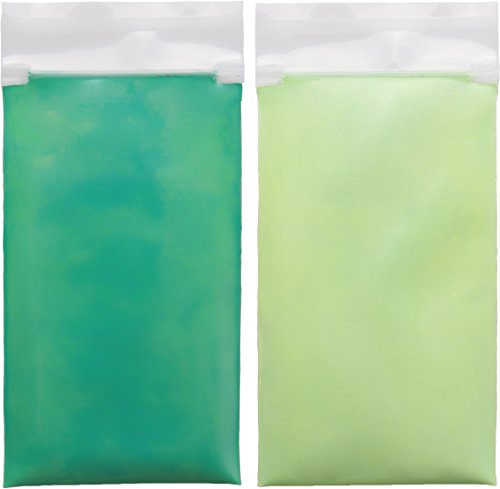
Ideal for artists who want a straightforward green-to-yellow transition around 82°F. The 20-gram package is convenient for larger projects like murals, resin art, and paint mixing. The powder is described as waterproof, expanding its usability across water-based mediums.
- Best for: Medium-to-large art projects and water-based mediums where stable color shifts are visible.
- Why chosen: Larger quantity and reliable color shift around the lower temperature threshold.
- Limitation: Color change temperature is relatively low, so outdoor or warm environments can affect visibility.
Renfio Thermochromic Powder – Lake Blue to Colorless
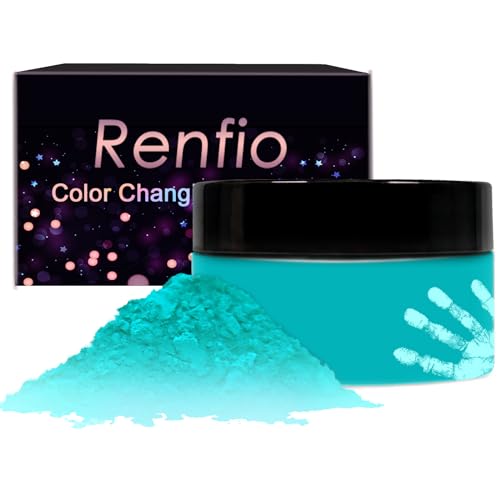
This bottle emphasizes reversibility and stable performance across cycles, with a transition around 82°F. Suitable for slime, nail polish, and resin color accents. It offers a longer-lasting application in projects that require repeated heating and cooling without a loss of effect.
- Best for: Projects needing repeatable color shifts over many cycles.
- Why chosen: Reversibility ensures consistent results in experimental setups and displays.
- Caution: Colors may appear differently on white vs. transparent bases; test a small amount first.
Atlanta Chemical Engineering Multicolor Pack

A versatile multicolor pack for students, hobbyists, and parents guiding science projects. The pack features a 77°F (25°C) trigger and emphasizes repeatable color changes in slime, resin, and DIY cosmetics. It’s well suited for school demonstrations and home experiments.
- Best for: Educational kits, classroom demonstrations, and beginner experimentation.
- Why chosen: Multicolor variety supports multiple lesson ideas and creative experiments.
- Limitation: Lower temperature threshold may reduce visibility of cool-phase color when in cooler climates.
Buying Guide: Thermochromic Powder For Slime And Crafts
What should you consider before buying thermochromic pigment powder?
- Color change temperature: Choose one that activates at a practical temperature for your project, whether around room temperature or warmer/hotter environments.
- Color range and reversibility: If you want multiple shades, pick sets with several colors and ensure the change is reversible for repeated use.
- Particle size and base compatibility: Finer powders mix smoothly with resin, nail polish, and paints. Check whether the powder works with water-based or clear bases to maximize effect.
- Quantity and packaging: For ongoing projects, larger packs offer better value; smaller packs are good for trial and controlled experiments.
- Safety: Ensure the product is labeled non-toxic or safe for craft use, especially when used with kids or skin-contact mediums.
Frequently Asked Questions
- What is thermochromic pigment powder used for in slime?
- Can these powders be used with resin and nail polish?
- Do these colors return after cooling?
- Are there safety concerns for children?
- How should I mix thermochromic powder with a base?
- Is clear resin or paint best for sharp color changes?
It creates color-changing slime that shifts hue with heat, adding a visual, interactive element to the slime-making process.
Yes. Most powders are designed to mix with clear bases and resin or nail polish for visible color changes.
Most options offer reversible color changes; the color typically returns to the original shade when temperature drops.
Products are usually marketed as non-toxic for art use, but supervision is advised, and avoid ingestion.
Start with a small amount of powder, then gradually add more while watching the color shift. Mixing may generate heat, which can influence the final color.
Clear bases typically provide more vivid color changes, as they let the pigment show through without muddling the transition.