Choosing the right piano key stickers can help beginners identify notes quickly, reinforce music theory, and keep keyboards clean. This guide highlights five popular options that cover silicone, vinyl, removable, and color-coded styles. Each listed product is designed for 88-key pianos and other common keyboard sizes, with materials that minimize residue and maximize durability. Read on to compare what each sticker set offers and find the best fit for practice sessions, classrooms, or home use.
| Product | Material | Key Compatibility | Notable Feature |
|---|---|---|---|
| Piano Keyboard Stickers for 88/61/54/49/37 Key (COYAHO) | Transparent vinyl, removable | 88/61/54/49/37 | Removable with no residue; durable lettering |
| BEATBIT Piano Notes Guide (Classic Black) | Silicone note strips | 88-key full size | No stickers required; double staff guide |
| Lrokimg Colorful Piano Keyboard Stickers | Transparent vinyl, removable | 88/76/61/54/49 | Bright colors for quick key identification |
| BEATBIT Piano Notes Guide (Rainbow Colors) | Silicone note strips | 88-key full size | Residue-free, easy installation |
| Eison Piano Keyboard Stickers (Leaves No Residue) | Vinyl stickers, double-layer coated | 88/61/54/49/37 | Bold letters, no ink fading |
Piano Keyboard Stickers for 88/61/54/49/37 Key
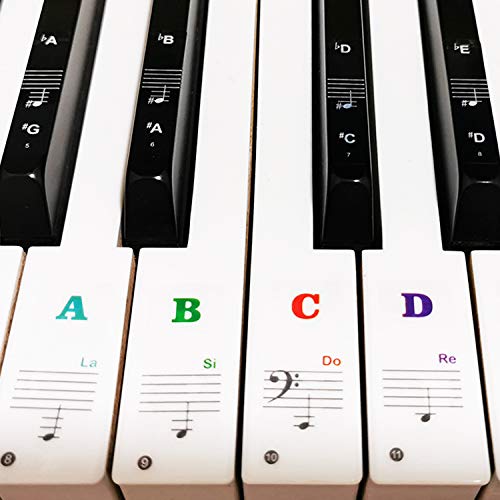
COYAHO’s sticker set is designed for broad compatibility across keyboards and pianos. The white key stickers measure 4.0 cm by 1.55 cm, while the black keys are 3.9 cm by 0.85 cm. The letters are printed on the backside of a transparent sticker, ensuring readability without distracting from playing. A key benefit is the durable, waterproof surface that can be wiped clean, keeping the keyboard looking neat. The adhesive is residue-free and allowing repeated repositioning, which is ideal for evolving layouts during learning.
BEATBIT Piano Notes Guide (Classic Black)

This BEATBIT option uses silicone note strips to avoid applying stickers directly to keys. The double-staff configuration helps students locate corresponding keys quickly, aligning with standard treble and bass staffs. It’s particularly beginner-friendly for those who prefer not to place stickers on the keyboard surface. Installation is straightforward, and removal leaves no residue, making it a clean solution for classrooms or practice spaces where multiple users share a instrument.
Lrokimg Colorful Piano Keyboard Stickers

Lrokimg offers color-coded, transparent vinyl stickers compatible with a wide range of keyboard sizes, including 88/76/61/54/49 keys. The stickers are designed to be barely perceptible during playing, with a focus on quick key recognition through bright, contrasting colors. They are easily applied and removed without leaving sticky residues, making them a practical option for beginners and teachers who need to reconfigure layouts frequently.
BEATBIT Piano Notes Guide (Rainbow Colors)

Another BEATBIT silicone-based solution uses a rainbow color scheme to help distinguish notes quickly. Like the classic black version, it eliminates the need for traditional stickers by using silicone strips that align with the keyboard’s layout. The double-staff display remains a core feature, aiding students in associating keys with staff notation. It’s reusable, residue-free, and simple to install in seconds, which makes it suitable for home practice and educational settings alike.
Eison Piano Keyboard Stickers (Leaves No Residue)

Eison’s full-key set covers 88/61/54/49/37-key instruments with bold, high-contrast letters on white keys and compatible black-key markings. The stickers use a double-layer coating to prevent ink fading and ensure legibility over time. They are designed to be easy to apply and remove, leaving no residue on the keyboard. This makes them a practical choice for beginners who want a straightforward, durable labeling system that won’t interfere with playing comfort.
Buying Guide: How To Choose Piano Key Stickers
When selecting piano key stickers, consider durability, residue, readability, and whether you prefer stickers, silicone strips, or a hybrid approach. Silicone-based guides eliminate surface adhesion, reducing the risk of sticky residues. Vinyl stickers with a transparent top layer typically offer crisp lettering while staying thin enough to feel natural under fingertips. Color coding and solfege systems can accelerate initial learning, but may require ongoing adjustments as skills progress.
- Keyboard compatibility: Confirm the sticker set supports your keyboard size (88, 61, 54, 49, etc.) and type (acoustic, digital, or hybrid).
- Residue and finish: If you share a keyboard or want to preserve resale value, choose residue-free options designed to wipe clean or remove easily.
- Readability: Bold fonts, high-contrast colors, and solfege can reduce delay in note recognition for beginners. Double staff guides help with visual mapping to staff notation.
- Installation and removal: Look for easy installation, repositioning, and non-destructive removal if you frequently reconfigure learning layouts.
- Durability and maintenance: Waterproof surfaces and durable inks ensure long-term legibility, especially for practice rooms or classrooms.
- For classrooms with multiple students, silicone-based solutions reduce the risk of adhesive residue and allow quick reconfiguration between sessions.
- If you want a visually engaging approach for kids, color-coded vinyl stickers with bold lettering can improve memorization speeds.
- For adults or performers who prefer minimal alteration to key surfaces, transparent and thin vinyl stickers are typically the least obtrusive.
- Consider whether you want built-in music theory aids like solfege (do, re, mi) to support incremental learning milestones.
- Check product support and replacement options, in case you need additional letters or sizes to fit different keyboards in the future.
All five options prioritize removable, residue-free designs, making them suitable for homes, studios, and classrooms. When in doubt, start with a silicone-based note guide if you want a non-adhesive approach, or choose transparent vinyl stickers for a classic labeling solution with high readability. Either way, proper placement and alignment will maximize comprehension and ease during practice sessions.