Seeking reliable screen printing ink suppliers for fabric and paper projects? This guide highlights top-priced, easy-to-work-with options that suit beginners and pros alike. The selected products are ideal for cotton, blends, and synthetics, with dependable heat-set durability. Best for hobbyists starting out, small studios needing consistent results, and professionals demanding vibrant colors. The table below summarizes the five chosen inks and sets for quick comparison.
| Product | Brand | What’s Notable |
|---|---|---|
| Speedball Fabric Screen Printing Ink, 8-Ounce, White | Speedball | Vibrant colors, versatile on fabric and paper |
| Speedball Fabric Screen Printing Ink Starter Set, 6-Colors | Speedball | Beginner-friendly, easy mixing, low odor |
| Speedball Fabric Screen Printing Ink, 8-Ounce, Black | Speedball | Strong contrast, good coverage for dark fabrics |
| Speedball 004660 Acrylic Screen Printing Ink, 128 FL OZ, White | Speedball | Large volume, acrylic formulation for durable prints |
| Speedball 004603 Fabric Screen Printing Ink, 32 Fl. Oz, White | Speedball | Balanced color, soft hand, easy cleanup |
Speedball Fabric Screen Printing Ink, 8-Ounce, White

Best for: Beginners and hobbyists working on cotton, polyester blends, linen, or synthetic fabrics. Why chosen: This ink offers vibrant coverage and a soft hand after heat setting, with reliable workability for consistent prints. Caution: Ensure proper heat setting to achieve permanence; fabric types can influence how well the ink cures.
Speedball Fabric Screen Printing Ink Starter Set, 6-Colors, 4 Fl Oz

Best for: New projects and color exploration. Why chosen: The set provides essential colors for mixing a wide color range, with water-based ink that cleans up easily. Caution: Great for beginners, but mixing and color matching may require experimentation for exact hues.
Speedball Fabric Screen Printing Ink, 8-Ounce, Black

Best for: High-contrast designs and dark fabrics. Why chosen: Black ink offers strong opacity and clean lines for text and bold graphics. Caution: Works best with proper curing; improper heat setting can affect permanence on certain fabrics.
Speedball 004660 Acrylic Screen Printing Ink, 128 FL OZ, White
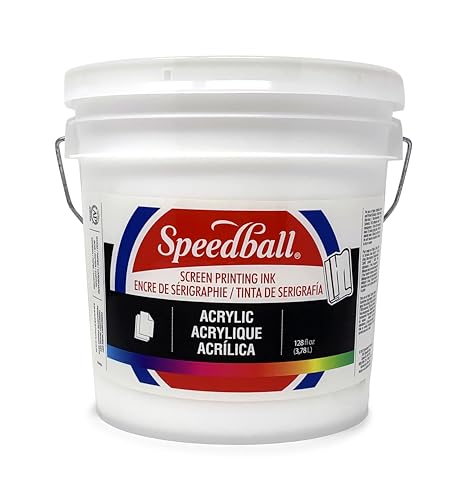
Best for: Large projects and professional work with durable prints. Why chosen: Acrylic inks tend to provide rich color and durability for paper, wood, and cardboard as well as fabric. Caution: Handle carefully in well-ventilated areas; follow safety guidelines for large volumes.
Speedball 004603 Fabric Screen Printing Ink, 32 Fl. Oz, White

Best for: Medium-to-large fabric runs needing a balance of opacity and softness. Why chosen: Offers a broad color range, softer handle, and easy cleanup compared with some heavier inks. Caution: Not recommended for nonporous fabrics such as nylon; test on experimental textiles first.
Buying Guide: Key Considerations When Choosing Screen Printing Inks
What fabric or surface will you print on?
Fabric types (cotton, polyester blends, linen, rayon) react differently to inks. Water-based inks are generally easier to clean and work well on natural fibers, while acrylic inks may offer greater durability on paper and cardboard. Consider whether you need versatility across fabrics or specialized performance for a single material.
Do you need a starter set or individual colors?
Starter sets help with color mixing and learning, especially for beginners. Individual colors are preferable when you know exactly which hue you will use most often or when you need a specific blackout or highlight color for a project.
What about drying time and heat setting?
Permanent results typically require heat setting. Check recommended curing instructions for each ink and ensure your heat source and temperature are appropriate for your fabric. Some inks also dry faster and are easier to work with for detailed designs.
Is cleanup important for your workflow?
Water-based inks offer easier cleanup with soap and water, which can reduce studio downtime. For larger batches, consider the ease of cleanup and whether you need dedicated washing facilities or portable cleaning options.
Volume and project scale
Large-volume projects benefit from bigger containers, like 32 oz or 128 oz, to reduce restocking frequency. Smaller sets are better for trial runs, color experiments, and limited editions.
Safety and certifications
Look for AP certification or similar safety markings if you’re producing items for children or sensitive populations. This helps ensure inks meet basic safety standards for indoor use and hand-to-mouth contact in textiles.
Color performance and durability
Consider color richness, opacity, washfastness, and how the ink performs on different substrates. A color that looks good on a swatch may appear differently on a finished garment after washing.
FAQ
- What should I consider when choosing screen printing inks for fabrics? Look at fabric compatibility, curing requirements, odor, cleanup needs, and whether the ink provides a soft hand after curing.
- Are water-based inks easier to use for beginners? Yes, water-based inks generally offer smoother workability, easier cleanup, and lower odor, making them beginner-friendly.
- Can I print on paper with fabric inks? Many fabric inks also print well on paper and cardboard, but verify the formula is suitable for nonporous surfaces if needed.
- Do acrylic inks require special curing? Acrylic inks usually require heat setting; follow the manufacturer’s instructions for best results and durability.
- Is a starter set better than buying individual colors? For beginners, a starter set supports color mixing and learning; for ongoing projects, adding individual colors can optimize your palette.
- What’s a good long-term option for large projects? Large-volume inks (32 oz or larger) reduce refill frequency and are cost-effective for big runs, provided you have the proper workspace and curing setup.