The best rose gold mica powder depends on how much pigment you need, how finely it blends, and what you plan to make. Renfio and Yipoyilo offer larger 100-gram jars for frequent projects, while Matio highlights fine particles and reusable packaging. Eye Candy lists a broad range of craft uses, and LightStone provides a 60-gram option with stated vegan and cruelty-free ingredients. Compare the product details below and check suitability for your specific project before use.
| Product | Best For | Listed Amount |
|---|---|---|
| Renfio Rose Gold | Large-volume crafting | 100 g |
| LightStone Rose Gold | Multi-project use | 60 g |
| Matio Rose Gold | Fine blending and storage | 50 g |
| Eye Candy Rose Gold | Versatile craft applications | 50 g |
| SEISSO Rose Gold | Pearlescent finish across crafts | 50 g |
Renfio Rose Gold Mica Powder

Best for: Makers who use rose gold pigment regularly and want a larger jar. Renfio supplies 100 grams and describes the powder as a natural mineral pearl pigment for projects including epoxy, soap, painting, slime, and bath bombs.
The listing says the powder is well mixed, has no clumps or balls, and that a small amount can create a noticeable effect. A small spoon is included for measuring and handling. These details make it a practical choice for repeated batches or varied DIY projects.
Limitation: The listing covers many different uses, but it does not establish that the product is appropriate for every skin-contact or cosmetic application. Check the manufacturer’s instructions for your intended use.
LightStone Rose Gold Mica Powder

Best for: Craft buyers who want a mid-size jar for resin, soap, nails, or bath-bomb projects. LightStone’s 60-gram container is larger than the 50-gram options here, without stepping up to a 100-gram supply.
The product description says the pigment is vegan and cruelty-free, and describes it as long-lasting, easy to use, and non-bleeding. It also says the powder can be blended with other colors, which may suit makers developing custom shades for resin or other listed crafts.
Limitation: The listing does not provide a particle-size measurement. If particle fineness is a key factor for your project, consider a product that specifies a micron range.
Matio Fine Rose Gold Mica Powder
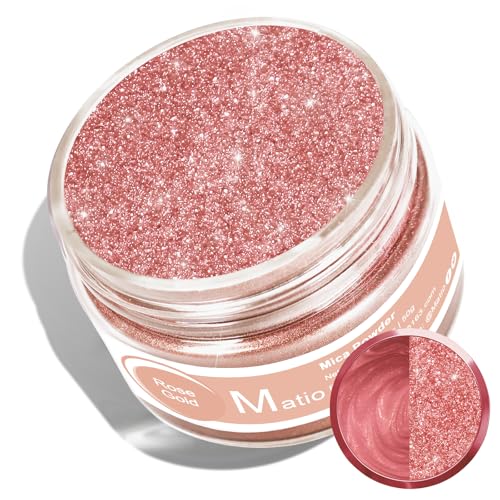
Best for: Makers who prioritize a fine texture and organized storage. Matio lists a particle size of 38 microns and says the pigment can blend with epoxy resin, latex, lacquer, nail polish, paint, polymer clay, varnishes, and glazes.
The product is packaged in reusable jars with color names on the labels. The listing also describes sealing layers intended to help prevent leakage during transportation. Its stated applications and particle-size detail make it a useful comparison for projects where blending and storage matter.
Limitation: The jar contains 50 grams, so high-volume users may prefer a larger package. Follow the product instructions when choosing a medium and measuring pigment.
Eye Candy Premium Rose Gold Mica
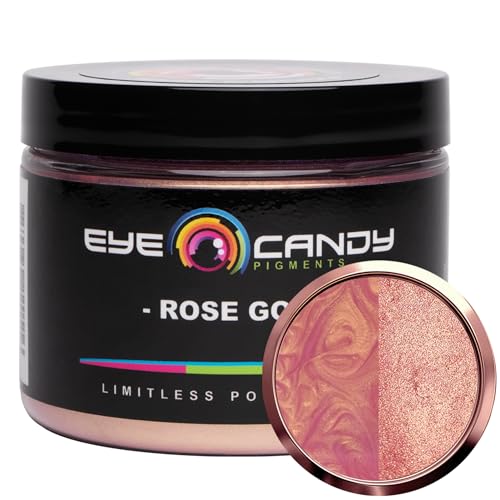
Best for: Crafters who want a pigment described for a broad range of art materials. Eye Candy lists uses including epoxy, resin, acrylic painting, slime, bath bombs, soaps, jewelry, plastics, candle making, and fishing lures.
The 50-gram powder has a stated particle range of 10–60 microns. The brand says its mica pearls can be integrated into materials such as lacquer, nail polish, polymer clay, varnishes, and glazes. That range makes it a flexible candidate for makers working across several types of craft.
Limitation: Its listed particle size is a range rather than a single measurement. Choose another option if a specific fineness is essential to your process.
SEISSO Rose Gold Mica Powder

Best for: Buyers seeking a 50-gram powder described for both craft coloring and cosmetic-related projects. SEISSO lists soap, resin, slime, nail products, lip gloss, and eye shadow among its suggested applications.
The listing describes a soft, non-caking texture and a pearlescent shimmer from the mineral pigment. It also says the powder can mix into transparent mediums and be used across a range of surfaces. For a rose-gold effect in crafts, the stated shimmer is a key point to compare.
Limitation: The description’s cosmetic claims do not replace checking the product label and applicable requirements for a particular skin-contact use. Do not assume that every mica powder is suitable for every cosmetic or body product.
Buying Guide: How To Choose Rose Gold Mica Powder
How much powder do you need?
Compare the net amount with your expected project volume. Renfio offers 100 grams, LightStone lists 60 grams, and Matio, Eye Candy, and SEISSO list 50-gram quantities. A larger jar can suit repeated use, while a smaller container may be easier to manage for occasional crafts. Amount alone does not indicate how much pigment a particular project will require.
Does particle size matter for resin?
Particle-size information can help compare products, but it does not guarantee a particular result in every resin. Matio lists 38 microns, while Eye Candy gives a 10–60-micron range. Check the instructions for your resin and test a small batch if you need to assess color, shimmer, or dispersion before making a larger piece.
Which applications should you check?
Product listings mention varied uses, including epoxy, soap, candles, bath bombs, nails, and cosmetics. A listing’s broad application claims should not be treated as proof of suitability for every formulation or direct skin contact. Confirm the product labeling and directions for the exact medium and intended use. For food-contact projects, verify suitability rather than relying on color-pigment claims alone.
How can you compare the finish?
Rose gold can look different depending on the medium, amount used, and how light reaches the finished piece. Product descriptions commonly refer to pearlescent or metallic shimmer, but the supplied details do not establish identical shades across brands. Review the product’s instructions and consider a small test to judge the finish in your own material.
Frequently Asked Questions
What is rose gold mica powder used for?
These listings describe uses such as resin art, soap, bath bombs, paint, slime, nail products, and other DIY crafts. Check each product’s instructions for the intended application.
Can I mix mica powder into epoxy resin?
The products featured here are described for resin or epoxy projects. Follow the resin and pigment directions, and test a small amount first to assess the result.
Is mica powder safe for cosmetics?
Do not assume that all mica powders are cosmetic-suitable. Verify the specific product labeling and intended-use information before using any pigment in cosmetics or on skin.
Which option comes in the largest amount?
Renfio lists a 100-gram jar, the largest stated amount among the five selected products.