Looking for the right needles for needle felting? This guide highlights five top kits that balance durability, variety, and value, helping you choose the best option for beginners, hobbyists, and serious crafters. Each product section explains who it’s best for, why it was selected, and any notable limitations to consider. A concise buying guide and FAQ follow to help you compare at a glance.
Summary table of selected products:
- IMZAY Needle Felting Tools – Best all-in-one starter kit for beginners and casual crafters
- Mayboos 132 Pc Wool Felting Needles – Best for comprehensive, long-term Projects
- Precision Felting Needles (Germany) – Best for precision work and professional use
- Yizzvb 30 PCS Needle Felting – Best for organized, budget-conscious crafters
- JUPEAN 18 Pieces – Best for compact sets with color variety
IMZAY Needle Felting Tools Kit

The IMZAY kit consolidates a wooden handle tool, finger protectors, and 30 felting needles across three sizes. It is ideal for beginners and casual makers who want a ready-to-go setup with comfortable ergonomics. The wooden handle supports quick, repetitive stabbing without slipping, improving control on larger projects. A potential limitation is the fixed configuration; replacement and expansion require additional purchases.
Mayboos 74 Pcs Wool Felting Needles

This set includes three needle sizes, a two-needle tool, finger cots, and multiple needle bottles, offering comprehensive coverage from fast-stab stages to fine detailing. It suits beginners who want a broad toolkit and intermediate crafters who appreciate organized storage. The wood-and-metal construction supports durability, though the assortment may feel overwhelming for complete novices who prefer fewer pieces to manage.
Precision Felting Needles – 15-Needle German Set

These Germany-made high-carbon steel needles emphasize precision and durability, with three popular sizes totaling 15 needles (36, 38, and 40 gauge). They’re best for experienced users or serious beginners who require consistent performance for sculpting, 3D modeling, and nuanced detail work. A caveat is that some users may prefer a broader gauge variety beyond the included three sizes.
Yizzvb 30 PCS Needle Felting Kit
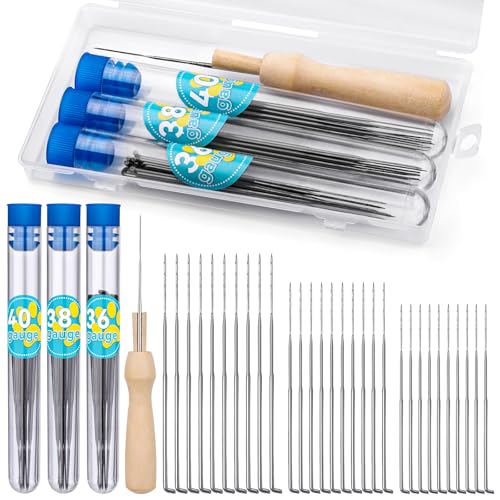
The Yizzvb kit offers three needle sizes (36, 38, 40 gauge) and a dedicated storage bottle for each size, aiding organization and quick selection during projects. This makes it especially suitable for hobbyists who value tidy tool management and clear size distinctions. A limitation is that only 30 needles are included, which may necessitate periodic replacements for heavy users.
Sample Set | Groz-Beckert German Precision Needles

This sample set focuses on precision and professional-grade performance, featuring three popular sizes (36, 38, and 40 gauge) and High Carbon steel. It’s best for crafters seeking reliable, long-lasting needles for detailed sculpting. If your projects are primarily beginner-level, you might opt for a broader kit with more size variety at a lower upfront cost.
Buying Guide
What should you look for in needle felting kits?
Durability, needle gauge variety, and ergonomic design are crucial. High-carbon steel needles tend to last longer and resist bending, while a mix of gauges supports both broad shaping and fine detailing. Ergonomic handles reduce hand fatigue during long sessions, and organized storage helps prevent misplacing tiny parts.
How many gauges do you need?
Common gauges are 36, 38, and 40. Lower numbers (36) cut fibers more aggressively, good for rapid shaping. Higher numbers (40) yield finer, smoother stitches. Beginners often start with 36 and 38, adding 40 for detail work as skill grows.
Should you prioritize kit completeness or portability?
Complete kits provide everything you need to start, including finger cots, bottles, and carrying cases. If you frequently work away from a fixed workspace, consider kits with compact cases and fewer loose parts.
What materials matter?
Look for high-carbon steel for durability. Wooden handles offer comfort and grip stability. Some sets use a mix of metal and wood; ensure the design suits your hand size and the amount of force you apply during felting.
Storage and organization tips
Keep needles in labeled bottles or a slim case to prevent loss and to quickly pick the right gauge. Color-coded needles or distinct bottle markings help you transition between project stages efficiently.
Which kit is best for you?
– Best for beginners: IMZAY or Mayboos 74 Pcs, due to ready-to-use bundles and ergonomic handles.
– Best for precision work: Desert Breeze Precision (German-made) or Groz-Beckert samples for consistent sharpness.
– Best for organized storage and portability: Yizzvb 30 PCS with separate gauge bottles.
– Best for compact sets with color variety: JUPEAN 18 Pieces, if space and color variety are priorities.
Quick comparison
- IMZAY: All-in-one starter with 3 sizes; ergonomic handle; good value for beginners.
- Mayboos 74 Pcs: Broad assortment; includes finger cots and bottles; strong beginner-to-intermediate option.
- Desert Breeze Precision: German precision; best for detail and longevity; higher emphasis on quality over quantity.
- Yizzvb 30 PCS: Clear size organization; balanced set for mid-range buyers; portable storage.
- JUPEAN 18 Pieces: Compact and color-coded; ideal for travel or light projects.
FAQ
- Q: Are higher gauge numbers better for beginners? A: Higher gauges (like 40) create finer holes; starting with 36 and 38 is often easier for basic shaping.
- Q: Do I need finger cots? A: Finger protection reduces fatigue and protects fingertips during longer sessions, especially with sharp needles.
- Q: Is it worth buying a German-made needle set? A: German-made sets emphasize precision and durability, which benefits serious crafters focusing on detail.
- Q: How many needles should a starter kit include? A: A starter kit with 20–40 needles across 2–3 gauges typically covers initial projects and adjustments.
- Q: Should I choose a kit with storage bottles and cases? A: Yes, organized storage helps prevent loss and accelerates tool selection during felting.
- Q: How do I maintain needle quality over time? A: Store needles dry, avoid bending, and replace bent or dulled needles promptly to ensure clean fiber engagement.