The best multi-layer pencil case depends on how you carry and sort supplies. The M&G is best for students who want a foldable, three-layer organizer, while the CICIMELON and Daisiki offer three compartments for separating everyday stationery. The VONXURY suits users who need dedicated pen loops and removable sleeves, and the Zannaki is better for protecting a larger collection of art supplies.
| Product | Best For | Organization Style |
|---|---|---|
| M&G Large Pencil Case | Flexible school use | Three layers and multiple slots |
| CICIMELON 3 Compartment Pouch | Everyday stationery | Three separate compartments |
| Daisiki 3 Compartment Organizer | Bulky supplies | Three compartments in a large case |
| VONXURY Pencil Case | Keeping pens in place | Elastic loops and detachable sleeves |
| Zannaki Storage Pouch | Art and journaling supplies | Layered, padded cover and mesh storage |
M&G Large Three-Layer Pencil Case

The M&G is best for students who want a soft, portable case with several ways to sort school supplies. Its three-layer compartment layout and multiple slots help separate pens, rulers, and erasers instead of leaving them loose in one large space.
The case measures 23 cm long and 11 cm deep. The listed capacity is up to 50 pens, and the product description says it can hold a 20 cm ruler, calculator, sticky notes, and other small items. Its trapezoid shape expands when open and folds down for carrying. A handheld strap adds another carrying option.
Choose this if you want flexible storage for a mix of stationery. Consider the limitation: the soft, foldable design does not provide rigid structure, so it may not suit buyers who want a hard-sided case.
CICIMELON Three-Compartment Pencil Case

The CICIMELON is best for students or adults who want to divide everyday stationery into three sections. Its compartments are designed to make different items easier to separate and find, which can be useful for keeping writing tools apart from sticky notes or small accessories.
It measures 9.25 by 2.95 by 3.74 inches and holds up to 50 pens or pencils, according to the product details. The lightweight, durable material is described as resistant to dust, tears, scratches, and abrasions. Strong metal zipper pulls are designed to be easier to grip and control.
Choose this if three distinct compartments matter more than individual pen loops. Keep in mind: its listed capacity is smaller than organizers described as holding 100 or more pens, so it may be less suitable for an especially large collection.
Daisiki Large Three-Compartment Organizer

The Daisiki is best for buyers who want a roomy, three-compartment pencil case for school or office supplies. Its 10-by-8-by-4-inch dimensions provide space for pencils, erasers, and other stationery, while the compartment layout helps keep different items organized.
The case is made from canvas, which the product description says is easy to wash and clean. Quality zippers are intended to open and close easily. Compared with a narrow pencil pouch, its stated dimensions make it a better option for people carrying a bulkier collection of supplies.
Choose this if you prioritize roomy storage and separated sections. Consider the limitation: the product details do not give a specific pen capacity or describe dedicated elastic holders, so it may be less suited to buyers who want every pen secured individually.
VONXURY Organizer With Detachable Sleeves

The VONXURY is best for users who want to secure writing tools in individual loops and adjust the interior layout. It includes 36 small elastic loops for pens or pencils and 18 larger loops for highlighters. Three interior mesh pockets provide extra space for items such as erasers, glue sticks, a small ruler, or a calculator.
Two detachable sleeves can be removed to create more room for larger stationery. The case also has a front zipper pocket and a top handle. Its listed dimensions are 9.5 by 7.1 by 2.8 inches, and its listed weight is 1.04 pounds.
Choose this if you carry many pens and want them held in place. Consider the limitation: the listed weight is heavier than a simple soft pouch, which may matter if you want the lightest possible pencil case.
Zannaki Padded Art Supply Pouch
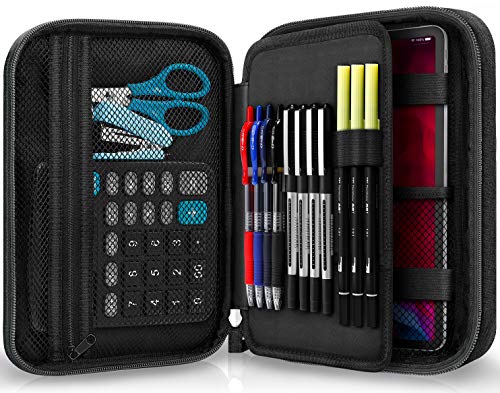
The Zannaki is best for artists, journalers, and students carrying a broad mix of pens and drawing tools. Its internal dimensions are 9.2 by 7 by 1.5 inches, and the product description says it can fit up to 100 standard-size pens and pencils. Flexible mesh storage is also described as accommodating items such as a sketchbook or small electronic device.
Its layered cover combines Oxford cloth, a water-resistant inner coating, foam board, and a polyester lining. The product details describe the foam as helping cushion stationery from bumps and the lining as helping resist tearing during everyday use.
Choose this if you want a protective pouch for art or journaling supplies. Consider the limitation: its flat, 1.5-inch internal depth may not work as well for unusually bulky items.
Buying Guide: How to Choose a Multi-Layer Pencil Case
Do you need compartments, loops, or flexible space?
Compartments are useful when you want to group supplies by type. Pen loops keep individual writing tools in place, as in the VONXURY. A flexible, open pouch can better accommodate varied shapes, while detachable sleeves let you change the layout when your supplies vary from day to day.
How much storage capacity do you need?
Check both the stated dimensions and the type of items you plan to carry. A listed pen capacity can help compare cases, but it does not guarantee that larger tools, calculators, or accessories will fit alongside a full set of pens. For art supplies, check internal dimensions and whether the design includes mesh pockets or adjustable sections.
Should you choose a soft, padded, or structured design?
A soft case can fold or fit into a bag more easily, while a padded design adds cushioning around stored supplies. Consider the trade-off between portability and protection. If you need to carry long rulers or bulky items, compare the case’s dimensions and shape before choosing.
What should you check before buying?
- Count the compartments and check whether they close separately.
- Look for pen loops if you want tools held in place.
- Compare dimensions with your longest or bulkiest supplies.
- Check whether the listed capacity matches your everyday carry.
- Consider material, zipper design, padding, and carrying handle based on how you plan to use the case.
Frequently Asked Questions
What is a multi-layer pencil case?
A multi-layer pencil case has multiple compartments, sections, or removable sleeves to separate and organize stationery. Some designs also include elastic loops or mesh pockets.
Which type is best for students carrying many supplies?
A high-capacity design with several compartments is useful for students carrying pens, rulers, erasers, and small accessories. Compare the listed capacity and dimensions to your actual supplies.
Are detachable sleeves useful?
Detachable sleeves are useful when you want to reorganize the interior or remove sections to make room for larger items. They may be unnecessary if you prefer a simple, fixed layout.
Is a padded pencil case necessary?
Padding can add cushioning for stored stationery. It is most relevant when you carry delicate art supplies or want more protection than an unpadded soft pouch provides.
How do I choose the right size?
Measure your longest tools and check the case’s listed dimensions. Also consider how many pens and accessories you carry, since capacity figures may not account for bulky items.