Answer: If you want reliable multi-color 3D printing, choose a system with an integrated color/filament manager and fast, precise performance. This guide highlights five prominent options and explains who benefits most from each. Best for hobbyists, designers, educators, and small studios seeking vibrant, multi-color prints with varying material support.
Below is a quick comparison of the selected models to help you decide at a glance. The table focuses on who each product is best for, how many colors it supports, and notable capabilities.
| Product | Best For | Multi-Color Capability | Key Strength |
|---|---|---|---|
| Bambu Lab P1S Combo | Creators who want fast multi-color printing with integrated AMS | Up to 16 colors | Lightning-fast speeds and enclosed design |
| Bambu Lab P2S Combo | Professional makers needing quick setup and high precision | Multi-color via AMS 2 Pro | 15-minute ready-to-print setup |
| FLASHFORGE AD5X | Educators and prototypers who want simple 4-color output | Up to 4 colors | 1-Click auto leveling and high speed |
| Bambu Lab A1 Combo + LED Lamp Kit | Creative projects with illumination and color | Multi-color via AMS lite | AMS lite enables accessible multi-color printing |
| Snapmaker U1 | Users needing robust multi-material capabilities | True multi-material, multi-color with 4 heads | 5-second tool changer for rapid color/material swaps |
The following sections detail each product. Each section notes who it is best for, why it was selected, and a practical caveat to consider before buying.
Bambu Lab P1S Combo: Fast, Enclosed Multi-Color Printing
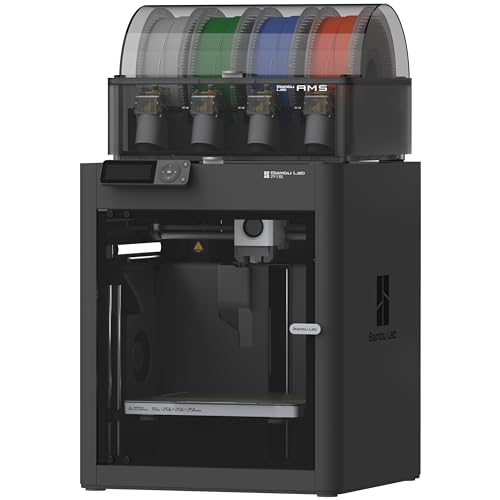
The Bambu Lab P1S Combo combines a P1S 3D printer with an AMS for multi-color printing. It supports up to 16 colors, making it ideal for vivid models, multicolor prototypes, and display pieces. An enclosed design protects the printing environment and helps with filament performance for diverse materials.
Best for: Creative designers and hobbyists who want vibrant color variety without extensive setup. The AMS integration is a key advantage for true multi-color workflows.
Limitation: Connecting the AMS is required for multi-color and multi-material prints, which adds setup steps and system dependency.
Bambu Lab P2S Combo: High-Precision, Ready to Print

The P2S Combo pairs a P2S printer with AMS 2 Pro for streamlined multi-color/multi-material printing. It touts up to 600 mm/s printing speed with stable layer results thanks to a PMSM servo extruder and active flowrate compensation. Setup is designed to be fast and automated, making professional-grade printing accessible to enthusiasts and professionals alike.
Best for: Professionals and advanced hobbyists who value speed, precision, and reliable color/material transitions in a single system.
Caution: The P2S printer itself does not support multi-color printing without the AMS 2 Pro combination; plan accordingly if you only own a single printer unit.
FLASHFORGE AD5X Multi-Color Printer: Four-Color Versatility

The AD5X offers vivid multi-color printing with support for up to four colors simultaneously. It features 1-click auto leveling for consistent bed height and a high-speed Core XY design that supports up to 600 mm/s, with strong acceleration. This is a strong choice for rapid prototyping and color-sensitive projects.
Best for: Classrooms, studios, and makers who want straightforward multi-color output with dependable auto-leveling and fast throughput.
Caution: While it supports multiple colors, the four-color limit may be restrictive for projects needing more hues in a single print.
Bambu Lab A1 Combo + LED Lamp Kit: Colorful, Illuminated Prototyping

The A1 Combo with AMS lite enables vibrant multi-color printing, complemented by an LED Lamp Kit for illuminating printed models. It emphasizes high-speed precision with an acceleration of 10,000 mm/s² and strong color capabilities, suitable for decorative pieces and functional lights.
Best for: Designers who want colorful models plus built-in lighting options for display or gifting projects.
Caution: AMS lite is required for multi-color capability; ensure you have access to the AMS lite or upgrade options.
Snapmaker U1: True Multi-Material, Quick Swaps

The Snapmaker U1 features four independent toolheads and a 5-second tool changer, enabling true multi-material and multi-color printing without tedious filament purging. It supports rigid, flexible materials, and soluble supports, making it versatile for functional prototypes and detailed models.
Best for: Makers and small teams needing high flexibility across materials and colors, with rapid head changes for mixed-material builds.
Caution: The four-head system can be more complex to operate; consider if your workflow benefits from automated tool swaps versus simpler single-material prints.
Buying Guide
What should you consider when selecting a multi-color 3D printer?
Color and material capabilities
Decide whether you need true multi-color printing, multi-material capability, or both. Some systems rely on external dispensers or AMS modules, while others offer integrated color handling. Consider the number of color channels you need for your projects.
Speed vs. precision
High speeds are valuable for prototyping, but acceleration and motion control affect finish quality. Look for printers with stable beds and reliable calibration features to balance speed with detail.
Filament handling
Filament drying, humidity control, and filament compatibility impact print reliability. Some models include built-in drying or sealed environments, which help with hygroscopic materials.
Ease of use
Auto leveling, automatic calibration, and intuitive interfaces reduce setup time. If you are new to multi-color printing, consider systems marketed for easy operation and quick start.
Upgrade paths
Check whether AMS modules, LED kits, or extra toolheads are compatible if your color or material needs grow. Some platforms require specific combinations to unlock full color capability.
What to avoid
Avoid models that claim broad color capability without clear how-to steps, or systems that rely on too many external components. A cohesive, single-brand ecosystem often yields fewer workflow headaches.
FAQ
- What is multi-color 3D printing? Printing with more than one color in a single model, often using dedicated color modules or multiple extruders.
- Do I need an AMS to print in multiple colors? Some printers require AMS modules to enable multi-color printing; others offer multi-color options built-in or via compatible kits.
- Is auto leveling important for color prints? Yes, auto leveling improves first-layer adhesion and color consistency across large or detailed models.
- Can multi-color printers handle fragile materials? Enclosed designs and controlled extrusion help with delicate filaments, but check each model’s filament compatibility.
- Are multi-color prints faster with more color channels? Not necessarily; speed depends on the overall printer architecture and how color changes are managed.
- What is AMS lite? A lighter multi-color module that enables basic color prints and can be an entry point before upgrading to a full AMS kit.