Choosing the right laser engraver for wood involves evaluating power, precision, working area, and ease of use. The following selections emphasize reliability, detailed engraving, and practical features for hobbyists and professionals alike. Each option supports wood engraving with strong performance and user-friendly setups, spanning compact units to larger, feature-rich machines.
| Product | Brand | Working Area | Key Strength |
|---|---|---|---|
| ACMER S1 Laser Engraver (6000mW) | ACMER | 130×130 mm | Ultra-fine accuracy and fast engraving |
| LONGER Ray5 (5W) | Longer | 400×400 mm | High speed, large working area |
| ACMER S1 Laser Engraver (3500mW) | ACMER | 130×130 mm | Same workflow, lower power option |
| LONGER Ray5 (10W) | Longer | 400×400 mm | Powerful 10W, advanced features |
| Carverall K15 Pro (5W) | Carverall | 200×300 mm | Compact, beginner-friendly with broad compatibility |
Note: Prices are not listed here. Specifications and capabilities vary by model; verify current details on the product pages before purchasing.
ACMER S1 6000mW Engraver

The ACmer S1 6000mW laser engraving machine features a 6000mW diode laser with a 2 mm focal length and a 455±5 nm wavelength. It offers up to 10,000 mm/min engraving speed and 0.01 mm repeatable positioning accuracy. The device supports engraving and cutting across wood, bamboo, leather, plastic, PCB, aluminum oxide, and ceramics. Aimed at users seeking high detail, this model emphasizes quick setup, with 99% preassembled components and a one-minute laser head installation. Suitable for DIY projects, crafts, and small-business tasks needing precise wood engraving and fine cuts.
Key points:
– 6000mW power with 48W output
– 130×130 mm working area
– 0.01 mm repeatable positioning accuracy
– 2 mm focal length for sharp detail
LONGER Ray5 5W Engraver

The LONGER Ray5 5W laser engraver delivers a 5W laser and a 400×400 mm working area. It is powered by a 240MHz ESP32 chipset for fast processing and supports high-precision engraving with a 0.08×0.08 mm laser spot and 0.01 mm accuracy. The device is designed for wood, metal, acrylic, and more, with an offline capability and a touchscreen for convenient operation. This model emphasizes speed and large-format projects, making it suitable for intricate signs, decorative pieces, and DIY crafts.
Key points:
– 5W power, 0.01 mm accuracy
– 400×400 mm working area
– 0.08×0.08 mm laser spot
– Offline capable with 3.5″ touchscreen
ACMER S1 3500mW Engraver

This model mirrors the 6000mW S1 with a lower 3500mW diode laser, maintaining 455±5 nm wavelength, a 2 mm focal length, and a 0.01 mm repeatable positioning accuracy. It supports engraving on a wide range of materials and includes a beginner-friendly, largely preassembled setup. The 130×130 mm working area makes it ideal for detailed wood engraving and small-canvas projects, especially for users seeking cost-effective entry into laser engraving for wood.
Key points:
– 3500mW power, 0.01 mm precision
– 130×130 mm working area
– Quick setup with simple head installation
– Broad material compatibility
LONGER Ray5 10W Engraver

The LONGER Ray5 10W laser engraver pushes power to 10,000 mW with a 400×400 mm working area. It features an upgraded ESP32 chipset for multi-device control, a 0.06 mm laser spot, and a 0.01 mm engraving precision. The package includes an air pump, rotary attachment, and 12 risers to enable engraving on cylindrical objects and taller pieces. This model is well-suited for users who require higher throughput and versatile accessories for wood, metal, glass, and more.
Key points:
– 10W power, 0.01 mm precision
– 400×400 mm working area
– Air assist and rotary attachment included
– Multi-device control with ESP32
Carverall K15 Pro 5W Engraver
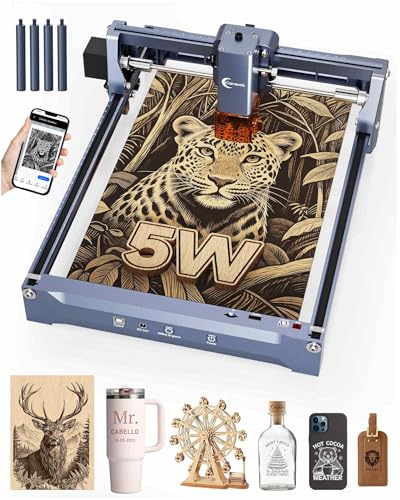
The Carverall K15 Pro provides true 5W+ output for engraving and cutting across multiple materials, including wood, coated metal, acrylic, leather, and more. It offers 0.01 mm precision and a rapid 15,000 mm/min speed. The device includes compatibility with CutLabX, LightBurn, and LaserGRBL, and comes with safety glasses and starter materials. Its compact size (near A4 footprint) and easy 90-second setup with six screws make it a practical choice for beginner to intermediate users seeking professional-level results in a small workspace.
Key points:
– True 5W power, 0.01 mm precision
– 200×300 mm working area
– Broad material support and software compatibility
– Quick assembly with included safety gear
Buying Guide
Power and material compatibility: Higher wattage enables faster cutting and deeper engraving, especially on hardwoods and coatings. If you primarily work with plywood, acrylic, and thin metals, a 5W to 10W unit with a decent spot size (0.06–0.08 mm) is typically sufficient for detailed wood work.
Working area and project scale: Larger work areas (e.g., 400×400 mm) support bigger signs, plaques, or panels. Smaller desks and hobbyist setups benefit from compact footprints (130×130 mm) while still delivering precise detail.
Precision and repeatability: Look for engravers offering 0.01 mm or better repeatable positioning accuracy. This matters for fine patterns, lettering, and intricate designs on wood surfaces.
Ease of use and setup: Beginner-friendly models with preassembled components, quick head installation, and accessible software interfaces save time and reduce the learning curve. Compatibility with widely used software like LightBurn and LaserGRBL is a practical bonus.
Reliability and accessories: Clear documentation, included safety equipment (glasses), and useful add-ons (air assist, rotary attachments, risers) extend the machine’s versatility and reduce extra purchases.
Connectivity and offline work: Machines with Wi-Fi, USB, TF card, and offline operation offer flexibility in various workshop environments. Consider offline functionality if you frequently operate away from a computer.
Cost and expansion: Balance initial cost with potential upgrades (additional power, larger bed, or accessories). If budget is a constraint, compare 3.5W–5W units for basic, quality wood engraving, keeping in mind upgrade paths.
Material safety and cut quality: Wood engraving produces particulates; ensure proper ventilation and safety practices. Evaluate test cuts or sample materials to judge edge quality, charring, and overall finish on wood surfaces.