Find the right high-heat orange paint for engines, headers, calipers, and other hot surfaces. This guide targets hobbyists and professional builders seeking durable color, heat resistance, and chemical protection. The top five picks prioritize orange shades that resist heat up to 2000°F and support motor parts exposed to oil, gas, and salt. Read each product’s strengths, ideal uses, and notable limits to choose confidently.
| Product | Why It Stands Out |
|---|---|
| VHT Flameproof Coating, Flat, Orange | Extreme heat resistance up to 2000°F; ideal for headers, manifolds, and exhaust systems |
| Rust-Oleum Automotive Engine Enamel Spray Paint, Gloss Orange Red | Good for automotive parts with intermittent temps up to 600°F; oil and rust resistance |
| Dupli-Color Engine Paint with CERAMIC, Gloss, Chevy Orange | Ceramic protection and high gloss; durable under oil and automotive fluids |
| VHT Engine Enamel, Gloss, Chevy Orange | Strong durability with heat and chemical resistance; designed for engines |
| Seymour EN-48 Hi-Tech Engine Spray Paint, Chevy Orange | Restores factory color with heat resistance up to 300°F; chemical and gas resistant |
VHT Flameproof Coating, Flat, Orange

Features: Ceramic resins resist heat up to 2000°F; renew and extend high-temperature surfaces; ideal for headers, manifolds, and exhaust systems.
Best for: Heavy-duty exhaust components and high-heat areas where extreme temperature tolerance is essential. This product is chosen for its outstanding heat endurance and protective ceramic formulation.
Caution: Flat finish may reveal texture after curing; follow heat-curing instructions to avoid uneven appearance.
Rust-Oleum Automotive Engine Enamel Spray Paint, Gloss Orange Red

Features: Ideal for automotive parts exposed to intermittent temperatures up to 600°F; rust preventive formula resists oil, gas, grease, and elements; dries to touch in 20 minutes and covers up to 12 sq. ft.
Best for: Engine bay parts, brackets, and supports that see routine heat but not extreme fire exposure. It’s a practical, quick-drying choice with solid corrosion protection.
Caution: Full cure requires adherence to label guidance; premature handling can mar the finish.
Dupli-Color Engine Paint with CERAMIC, Gloss, Chevy Orange

Features: Ceramic-enhanced coating for maximum heat dissipation and high gloss retention; will not blister, flake, crack, or peel; resistant to oil and other automotive fluids.
Best for: Vehicles requiring long-lasting color and gloss on engine components where a ceramic boost improves heat management.
Caution: Ceramic formulations can require longer curing times in cooler environments.
VHT Engine Enamel, Gloss, Chevy Orange
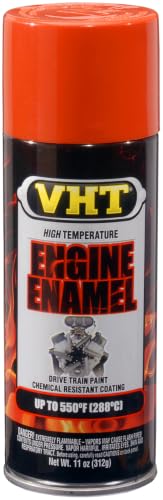
Features: Excellent durability; strong heat and chemical resistance; formulated to withstand corrosion, rust, salt spray, and additives.
Best for: Engine blocks and cylinders that experience heat cycling and exposure to harsh chemicals; offers durable color with protective properties.
Caution: Gloss finish may require clear coating for UV stability in exterior exposure scenarios.
Seymour EN-48 Hi-Tech Engine Spray Paint, Chevy Orange

Features: Restores original factory color to engines, transmissions, and OEM equipment; durable coating under varied stress; heat resistant up to 300°F; chemical and gas resistant.
Best for: Restoration of factory-colored engine components and areas not exposed to extreme high heat; emphasizes color accuracy and resistance to common automotive fluids.
Caution: Not suitable for surfaces that reach very high temperatures above 300°F for extended periods.
Buying Guide
What heat rating do you need?
Choose based on expected temperatures. For headers, manifolds, and exhaust systems, select coatings rated at very high heat (up to 2000°F). For engine bays with moderate heat, coatings rated up to 600°F or 650°F may be sufficient.
Gloss vs. flat finishes
Gloss finishes look clean and help reveal color depth, but flat or satin finishes often hide imperfections and may wear differently on moving parts. Consider environmental exposure and cleaning needs when selecting a finish.
Chemical and solvent resistance
Engine areas encounter oil, gasoline, brake fluid, and road salts. Look for coatings explicitly labeled resistant to oils and chemicals. Ceramic-enhanced formulas offer additional protection in demanding conditions.
Cure time and recoat window
Dry-to-touch and handling times impact project timelines. Short cure times help speed up projects, but ensure you follow label directions for full cure and adhesion.
Application and surface prep
Proper preparation improves adhesion and lifespan. Degrease, remove rust, and lightly scuff the surface. Some products require heat curing; follow temperature recommendations precisely.
Color accuracy and availability
When matching OEM colors, verify the exact shade name (for example Chevy Orange variants) and compare swatches if possible. Some lines offer multiple orange hues for different engine families.
Safety and ventilation
Spray coatings release fumes. Use in a well-ventilated area with appropriate PPE. Ensure surfaces have cooled before handling after cure.
FAQ
What is the highest temperature a high-heat orange paint can withstand?
Many products list endurance up to 2000°F for exhaust components; users should follow product-specific cure and use instructions for best results.
Can these paints be used on calipers and rotors?
Caliper paints exist in orange varieties; select a product designed for brake components if applying near braking surfaces and follow manufacturer guidelines.
Do ceramic additives improve heat resistance?
Yes, ceramic additives help with heat dissipation and gloss retention, improving longevity under heat and exposure to oils.
How long before I can handle parts after painting?
Most products offer a “dry to touch” time in minutes and a longer cure period for full hardness. Check the label for exact times and conditions.
Is a clear coat necessary?
Often optional. Clear coats can improve UV resistance and gloss retention on exterior-facing parts, but may affect heat dissipation in some applications. Follow product guidance.
Are there differences between engine enamels and caliper paints?
Engine enamels focus on heat and chemical resistance for engine surfaces, while caliper paints emphasize heat, brake dust, and chemical resistance specific to braking systems.