Looking for a reliable hat heat press that delivers even transfers on caps? This guide highlights five of the best options for different needs, from high-pressure models for DTF and embroidery to user-friendly picks for beginners. The top picks are best for small shops, DIY crafters, or busy studios seeking consistent results and easy operation.
The following table compares key traits to aid quick decisions:
| Product | Best For | Key Feature | Notes |
|---|---|---|---|
| HTVRONT Auto Hat Press | Small businesses and DIY crafters | One-Touch automatic operation; 80 kg pressure; dual platens | Excellent for DTF, embroidery, and sublimation transfers |
| VEVOR 4-in-1 Hat Press | Beginners to intermediate crafters | Four interchangeable pads; large heating plate; digital controls | Great versatility for different hat shapes |
| EENOUR Hat Press | Professionals needing two cap platens | Two quick-swap platens; memory and precise control | Solid curve conformity for wrinkle-free results |
| OLIXIS Hat Heat Press | Cap enthusiasts and designers | 3.2″x5.5″ curved plate; memory mode; safety base | Accurate temp/time with easy operation |
| HTVRONT Hat Press with Caps Stretcher | Caps with diverse designs | Two platens; memory mode; non-slip base | Stable press and straightforward workflow |
HTVRONT Auto Hat Press Machine

The HTVRONT Auto Hat Press uses one-touch operation to lower and lift automatically, delivering consistent pressure and timing with minimal manual effort. This feature makes it well suited for small businesses, studios, and DIY crafters who value efficiency without sacrificing transfer quality. The machine claims over 80 kg of pressure, which supports reliable transfers for DTF film, embroidery patches, and other thick substrates. Included dual hat platens let users switch between adult and kids’ caps quickly, aiding batch production. A potential limitation is that extremely delicate fabrics may require careful settings to avoid creasing.
Best for: small shops or creators who prioritize automation and strong, repeatable pressure for a variety of cap transfers. Choose this if you transfer DTF films, embroidery patches, or rhinestones and want faster turnaround with consistent results.
VEVOR 4-in-1 Hat Press
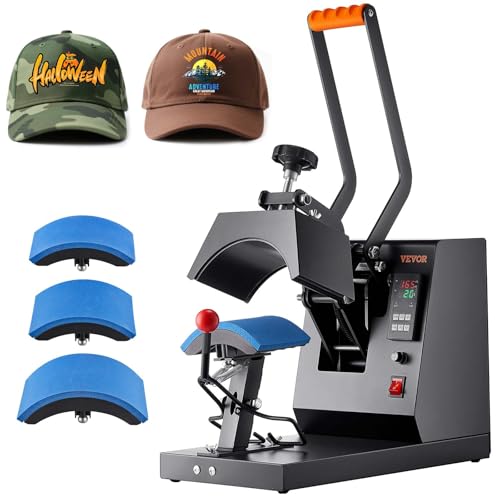
This 4-in-1 hat press comes with four interchangeable heating pads (6×3, 6.7×2.7, 6.7×3.8, and 8.1×3.5 inches). The larger 8.5×4 inch heating surface suits a variety of hat styles, including berets and bucket hats, broadening creative options. The device features a cast aluminum, Teflon-coated plate and a digital control system displaying Fahrenheit and Celsius. A caution is that users should avoid abrupt handling to ensure pads stay aligned during swaps. Best for beginners who want multi-size capability without buying multiple machines.
EENOUR Hat Press

The EENOUR hat press provides two quick-swap platens (3.1″ x 5.9″ and 3.7″ x 7″), enabling compatibility with a wide range of cap shapes. Its rapid heating with a cast-aluminum plate aims to reduce hot spots for uniform transfers. The upgraded curved pad helps minimize wrinkles for a professional finish. This model suits users who need versatility across cap types and a straightforward workflow. A limitation is that larger or unusual shapes may require careful placement to avoid uneven pressure near edges.
OLIXIS Hat Heat Press
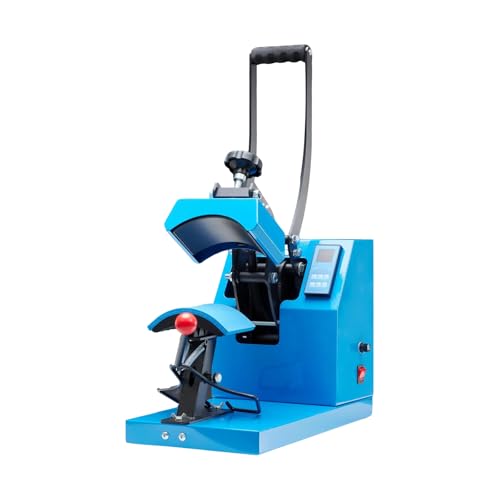
The OLIXIS hat press emphasizes precise temperature and time control, with a curved 3.2″x5.5″ heating plate designed to fit most cap styles. Its memory mode stores preferred settings for repeatability, and a safety base provides stability during operation. This option is best for designers who value consistent results and a simple workflow, especially when applying detailed designs. A potential limitation is the smaller plate could be less efficient for bulk transfers on larger hats.
HTVRONT Hat Press With Caps Stretcher (White)

This HTVRONT model features two platens and a caps stretcher for improved alignment and fabric handling. The manufacturer highlights fast, even heating with a cast aluminum plate and an upgraded four-bar linkage for easier operation. The dual platen setup aims to minimize wrinkles and ensure a consistent transfer across different cap shapes. Best for designers who need a stable setup and memory-friendly controls. A caution is that users should iron caps flat before pressing to maximize results.
Buying Guide
- Cap variety and platen size: Consider whether you need multiple cap sizes or shapes. Two platens help accommodate a wider range of hats, while larger pads improve coverage for bulkier designs.
- Pressure and temperature control: Look for machines with precise digital readouts and memory modes to maintain consistent results across sessions.
- Ease of use: One-touch operations and quick-swap platens reduce setup time, especially in small businesses or busy studios.
- Durability and heat distribution: Cast aluminum plates tend to distribute heat evenly and last longer than silicone. Teflon coatings reduce sticking and simplify cleanup.
- Safety and stability: A non-slip base or caps stretcher can improve handling and reduce the risk of misalignment during transfers.
FAQ
- What transfer methods work best with hat presses?
Transfers from DTF film, embroidery patches, rhinestones, and sublimation are common, but check each model’s compatibility with your materials. - Do I need memory mode?
Memory mode helps store frequently used settings for repeatable results, especially in production runs. - Are two platens better than one?
Yes for versatility and faster switching between cap sizes; you can press multiple hats with less downtime. - Is a larger heating plate always better?
A larger plate covers more of a cap but may be less precise for tiny logos. Choose based on your most common cap styles. - What maintenance is required?
Clean the platen surface, avoid overheating, and align cap platens regularly to maintain even pressure. - Which model is best for beginners?
A model with multiple size pads, clear digital readouts, and straightforward loading—such as the VEVOR or EENOUR—offers a gentle learning curve.