Choosing the right fabric and supplies for screen printing can dramatically improve print quality and consistency. This guide highlights reliable fabrics and ink sets that work well for beginners and pros alike. Whether you’re preparing textiles for apparel or home decor, the following products offer strong mesh stability, good ink transfer, and durable finishes.
| Product | Mesh Type / Size | Key Benefit |
|---|---|---|
| MS WGO Silk Screen Printing Fabric Mesh (110 Mesh) | 110 Mesh (43T) | High tension stability for precise reverses and clean ink gaps |
| MS WGO Silk Screen Printing Fabric Mesh (160 Mesh) | 160 Mesh (64T) | Finer mesh for detailed designs and smoother ink laydown |
| EQUTY BAYMERS Silk Screen Printing Fabric Mesh | 110 Mesh | Durable monofilament polyester, strong under tension |
| Speedball Fabric Screen Printing Ink Starter Set | Water-based inks, 6 colors | Vibrant, easy mixing, beginner-friendly with washable cleanup |
| Smalltongue Fabric Screen Printing Ink, 8 Colors | 8 colors, 120 ml each | Waterproof, UV-stable, multi-surface versatility |
Below, each selected product is examined for suitability, usage notes, and how it compares within a practical screen-printing setup.
MS WGO Silk Screen Printing Fabric Mesh, 110 Mesh

The MS WGO 110 Mesh screen printing fabric uses high-quality polyester filaments to form a durable monofilament mesh yarn. The fabric supports high tension and demonstrates uniform mesh formation with strong dimensional stability. This makes it suitable for bold solid fills as well as fine halftones, depending on exposure and stencil quality. The mesh is designed to withstand the ink flow during printing, which helps maintain edge definition and repeatable results across multiple prints. This option is ideal for apparel and textiles that require reliable performance without frequent mesh replacement.
MS WGO Silk Screen Printing Fabric Mesh, 160 Mesh

This MS WGO mesh features a finer 160-mesh count, enabling better detail and smoother ink transfer. The fabric is built with monofilament polyester yarns produced on precise machines to ensure uniformity across the print area. Its good tension stability helps minimize mesh sag during printing, which is essential for high-detail designs or multi-color separations. While higher mesh counts can reduce ink deposit per pass, they deliver crisper lines and reduced substrate saturation, making them a strong choice for quality-oriented projects on cotton, blends, and related fabrics.
EQUTY BAYMERS Silk Screen Printing Mesh, 110 Mesh

EQUTY BAYMERS offers 110-mesh monofilament polyester screen printing fabric designed for high-tension scenarios. This mesh emphasizes dimensional stability and resistance to deformation under stress, making it suitable for longer print runs. The robust material supports accurate mesh formation so that ink deposition remains consistent across the print field. It’s compatible with a broad range of fabrics and is well-suited for beginners seeking forgiving performance or for seasoned printers pursuing dependable repeatability.
Speedball Fabric Screen Printing Ink Starter Set

The Speedball Starter Set brings a six-color palette of water-based inks designed for ease of use and broad fabric compatibility. The inks are water-soluble, deliver smooth, uniform coverage, and are easy to clean up with soap and water. They are known for low odor and are suitable for beginners and experienced printers alike. When heat-set, these inks offer durable, long-lasting results. The color range supports practical color mixing for bold designs on cotton, blends, linen, and synthetic fabrics, making this set a versatile entry point into screen printing.
Speedball Fabric Screen Printing Ink, White

Speedball’s White Fabric Ink offers strong visibility on dark or colored fabrics and pairs well with other colors for high-contrast designs. The ink is designed to provide vibrant results with consistent coverage across a range of textiles, including cotton, polyester blends, linen, and rayon. It yields a soft hand on the finished garment and becomes permanent after proper heat setting. In multi-color work, white serves as a reliable base for lighter designs and as a bright highlight across various substrates.
Smalltongue Fabric Screen Printing Ink, 8 Colors
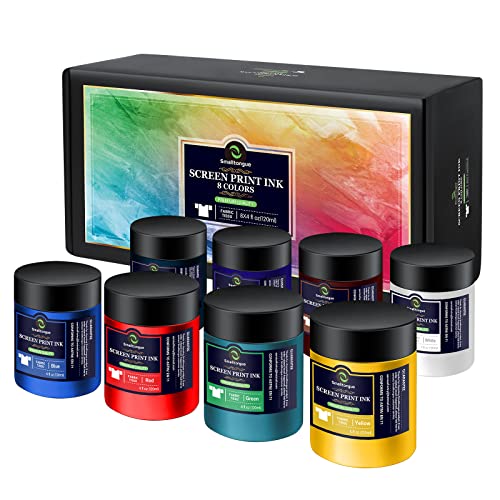
The Smalltongue ink set provides eight vivid colors ready for mixing and design creation. The kit emphasizes water resistance and sunlight durability after proper drying and curing, making it suitable for textiles and home decor projects. The versatility extends to other synthetics like polyester blends and linen, allowing for broad experimentation. The color range supports primary, secondary, and tertiary hues, enabling printers to craft custom palettes for bold graphic tees and fabrics with complex artwork.
Special Fabric Screen Printing Ink, Red

Special Fabric Screen Printing Ink in Red offers robust color performance, reliable coverage, and consistent workability. It is designed for a broad fabric range including cotton, polyester, blends, linen, and rayon, with compatibility for synthetics and papers. The ink is intended to provide a soft hand on the fabric and becomes permanent after proper heat setting. This makes it a practical option for designs that require a strong red hue across varied substrates and projects needing durable color retention.
Buying Guide: Key Purchase Considerations
- Mesh count and fabric compatibility: Higher mesh counts (e.g., 160) yield finer detail but deposit less ink per pass. Lower counts (e.g., 110) are sturdier and better for solid fills on medium-to-heavy fabrics. Match mesh to your design complexity and substrate.
- Material quality and tension stability: Look for monofilament polyester meshes with uniform weave and good elasticity. Stable tension reduces distortion during printing and helps preserve design sharpness across runs.
- Ink type and substrate compatibility: Water-based inks are easy to use and cleanup, ideal for cotton and blends. Plastisol-style and specialty inks offer bold finishes but require proper curing. Always verify fabric compatibility with the chosen ink.
- Setup and maintenance: Starter sets are convenient for beginners, offering ready-to-use color options. Ensure you have a suitable squeegee, exposure system, and heat source for curing inks reliably.
- Durability and durability testing: When printing for apparel, consider wash-fastness and colorfastness. Colors like white or bright primaries should be tested on the target fabric to gauge hand feel and wash outcomes after curing.
- Cost and scalability: If planning multiple colors or long print runs, factor in the cost per print, the availability of mesh replacements, and the ease of maintaining consistent tension across frames.
- Safety and cleanup: Choose inks with non-toxic formulations when possible and follow proper cleanup protocols to preserve equipment integrity and reduce exposure.