Cosplay prop building relies on reliable foam materials that are easy to cut, shape, and endure cosplay day wear. This guide highlights five standout foam options, including high-density EVA sheets and moldable foam clay, to help you select the best foam for armor, props, and costumes. Each pick balances durability, workability, and value, so builders can choose according to project size, detail, and end-use.
Summary of Selected Products
- MEARCOOH Black Foam Sheets Roll, 5mm, 59″ x 13.9″ — durable, shape-retaining EVA foam for large builds
- Pixiss Moldable Cosplay Foam Clay (White), 300g — air-dry, lightweight, great for intricate details
- The Foamory Shape Retention EVA Cosplay Foam, 2mm, 14″ x 39″ — ultra-dense, ideal for precise detailing
- LabZhang Grey EVA Foam Cosplay, 2mm, 14″ x 39″ — high-density, smooth both sides for clean finishes
- MEARCOOH Black Eva Foam Sheet Roll, 10mm, 13.9″ x 39″ — thick, sturdy for armor and bold pieces
This guide provides a balanced look at each option, focusing on thickness, density, and practical cosplay applications. Readers will find how these foams perform in cutting, shaping, heating, sanding, and assembling, along with tips for achieving durable, professional results.
MEARCOOH Black Foam Sheets Roll — 5mm, 59″ x 13.9″

This large EVA foam roll offers substantial material for expansive armor pieces, cloaks, or large prop components. The 5mm thickness provides a solid balance of rigidity and flexibility, enabling clean cuts and reliable shaping. The material is formulated to retain its shape under use, helping cosplayers maintain the integrity of their builds over multiple events. It is suitable for painting, detailing, and mounting hardware without sacrificing durability.
Key strengths include a generous size and durable density that supports both beginner and intermediate projects. When working with heat to form contours, the foam responds well, holding curves and edges with minimal warping. For beginners, this sheet size reduces seams, and for seasoned builders, it offers enough material for sizable prop work in a single sheet.
Practical tips: use sharp blades for clean edges, apply heat cautiously to avoid over-softening, and seal surfaces before painting to improve finish quality. The material’s low odor and consistent surface help keep the workshop environment comfortable during long sessions.
Pixiss Moldable Cosplay Foam Clay (White) — 300g

Pixiss foam clay is a white, high-density, air-dry foam clay designed for intricate cosplay and crafting work. This material blends sculptural flexibility with durability, making it ideal for detailed armor accents, props, and small-scale components that require refined shaping. The clay is lightweight, which helps keep overall costume weight manageable while maintaining the capability to hold delicate features.
Its air-dry nature reduces mess and cleanup compared to traditional clay, and it pairs well with EVA foam for hybrid builds. The clay accepts cutting, sanding, and light shaping tools, enabling precise lines and textures. Once dry, it forms a solid, paintable surface that holds poise during wear and transport.
Usage considerations include working in thin layers to prevent cracking and allowing adequate cure time for each layer to ensure maximum strength. The material suits beginners seeking a forgiving medium and professionals needing quick, detailed additions to their foam builds. It can be combined with EVA foam for mixed-media prop designs.
The Foamory Shape Retention EVA Cosplay Foam — 2mm, 14″ x 39″

This 2mm high-density EVA foam sheet emphasizes shape retention and durability, making it well-suited for small-to-medium cosplay components such as armor accents and detailed props. The 14″ x 39″ dimension provides a wide swath of material per sheet, reducing seams and enabling larger single-piece designs. The manufacturer highlights its true density of 85 kg/m3, which supports clean cuts, reliable sanding, and effective heating for shaping.
Applications include crafting helmets, curved armor, and accessory elements that demand precise contours. The foam’s smooth surface on both sides eases engraving and scoring for intricate patterns. For sewers, the sheet thickness supports lightweight, wearable pieces that still hold form under routine cosplay movement.
Tips for best results: pre-plan piece layouts to minimize cutting waste, test heat-shaping on scrap pieces, and seal surfaces before painting to achieve a professional finish with consistent color and texture.
LabZhang Grey EVA Foam Cosplay — 2mm, 14″ x 39″

The LabZhang grey EVA sheet is a 2mm, 14″ x 39″ sheet of ultra-high-density EVA foam. This material’s smooth surface on both sides supports clean sanding, precise cutting, and detailed engraving. With a density around 80 kg/m3, it offers reliable resilience for cosplay builds that require more elaborate shapes while remaining easy to work with for armor pieces and accessories.
Ideal use cases include armor details, bracers, and lightweight components that must be shaped with accuracy. The large single-sheet size reduces seams, making it easier to assemble cohesive builds. Whether you’re creating helmet rims, gauntlet accents, or stylized armor panels, this foam provides a solid base with forgiving workability.
Tips: test fitments on mockups before transferring to the foam, use light sanding for a smoother surface, and consider edge treatments to hide seams in larger pieces. A good sealant or primer helps achieve a uniform paint finish across brushed or matted surfaces.
MEARCOOH Black EVA Foam Sheet Roll — 10mm, 13.9″ x 39″

This 10mm thick MEARCOOH EVA foam sheet delivers substantial rigidity for heavy-duty cosplay armor and large-scale props. The thick sheet makes it suitable for chest plates, pauldrons, and other high-impact components that require structure and robust shaping resistance. It remains workable with standard tools, and the dense foam accepts heat shaping with controlled bending and contouring.
The surface is designed for a uniform finish with minimal warping during heating. When painted, the foam can achieve bold color blocks and crisp lines, enhancing visual impact for cosplay armor and prop builds. Given its thickness, planning is essential to manage weight and fit, especially for full-body ensembles.
Builder guidance: use internal supports for complex forms, test bending radii on scrap, and consider combining with thinner sheets for layered armor designs to optimize mobility and weight distribution.
The Foamory Shape Retention EVA Cosplay Foam — 3mm, 14″ x 39″
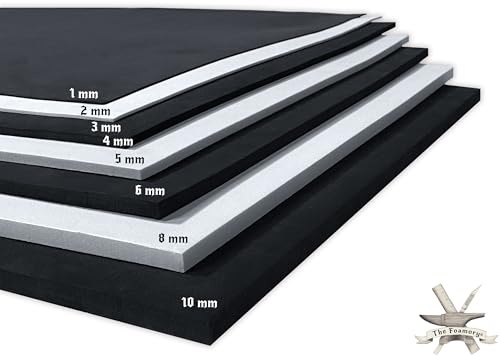
The 3mm variant from The Foamory balances detail with durability, ideal for masks, curved accessories, and mid-sized props. The sheet size remains generous at 14″ x 39″, helping reduce seams while enabling more—all-purpose design opportunities. The foam’s high-density composition supports precise engraving, scoring, and shaping, with enough flexibility for wearing comfort in certain designs.
Practical considerations include testing edge durability on mixed-media builds and using a heat gun to form gentle curves. For intricate features, consider layering with thinner sheets or combining with foam clay for texture before painting. This thickness is a versatile option for those seeking a middle ground between delicate parts and solid armor sections.
The Foamory Shape Retention EVA Cosplay Foam — 4mm, 14″ x 39″
This 4mm sheet offers ample stiffness for more substantial armor components or larger props while still maintaining workable pliability for shaping and detailing. The 14″ x 39″ footprint minimizes seams and supports ambitious projects like helmets, chest pieces, or larger prop panels. Its 85 kg/m3 density contributes to enduring form retention during wear and transport.
Designers should consider layering thicker foam with thinner interior supports to optimize strength and weight. For finish quality, a sealant and primer are recommended prior to painting to lock in color and texture across curved surfaces and edge lines. This thickness is well-suited for durable cosplay builds that demand a professional, long-lasting look.
Buying Guide: Key Purchase Considerations
- Project scope and thickness: Thinner foams (2–3mm) excel for detailed armor and accessories, while thicker sheets (5–10mm) are better for large armor plates and rigid props.
- Density and durability: Higher density foams offer better shape retention and resistance to bending, but may require more effort to cut and shape.
- Sheet size and seams: Larger sheets reduce joins but can add weight; smaller sheets offer flexibility and easier storage.
- Workability: Some foams respond well to heat shaping, sanding, and engraving. Consider whether you’ll use tools like scalpels, rotary tools, or heat guns.
- Finish and compatibility: Surfaces that are smooth on both sides accept paints and sealants evenly. Plan for primers and sealants to achieve professional finishes.
- Hybrid strategies: Mixing EVA foam with foam clay enhances texture and detail while keeping overall weight manageable.
- Storage and transport: Foam thickness and sheet size affect how easily the costume can be transported and stored between events.
- Safety and odor: Choose materials formulated for low odor and safe handling, especially for indoor crafting spaces.
Different builders prioritize texture, color, and edge quality. For large-scale builds, combining thick sheets for main armor with thinner sheets for detailing often yields the best balance of durability and maneuverability. For precise, sculpted features, foam clay can complement EVA foam, enabling intricate designs without adding excessive bulk. By evaluating thickness, density, and finishing options, cosplayers can tailor a kit that suits both their artistry and their performance needs.