Direct answer: For clayboard or clay-coated painting surfaces, Ampersand’s Museum Series Claybord panels and Aquabord panels offer ultra-smooth grounds ideal for detailed pencil, ink, acrylic, gouache, tempera, and oils, while the Kaolin clay panels provide a uniquely receptive ground for fine control. This guide highlights five top options, who they are best for, and practical considerations to help you choose.
| Product | Size | Best For | Main Benefit |
|---|---|---|---|
| Ampersand Museum CBS08 | 8×10 in | Detail-oriented painters, Inks & Mixed Media | Velvety smooth, highly absorbent surface |
| Ampersand Museum CBS05 | 5×7 in (pack of 3) | Compact studies, Travel-ready works | True Kaolin-like surface on a small panel |
| Ampersand Museum CBS11 | 11×14 in | Larger compositions, Oils & Gouache | Versatile archival clayground for multiple media |
| Ampersand Kaolin Clay Panel | 2.5×3.5 in (pack of 5) | Detail work, Miniatures | Ultra-smooth, true kaolin clay ground |
| Ampersand Aquabord CBT088 | 8×8 in | Watercolor & Gouache | Color lifting and vibrant, wet-on-wet control |
Ampersand Museum CBS08 – 8×10
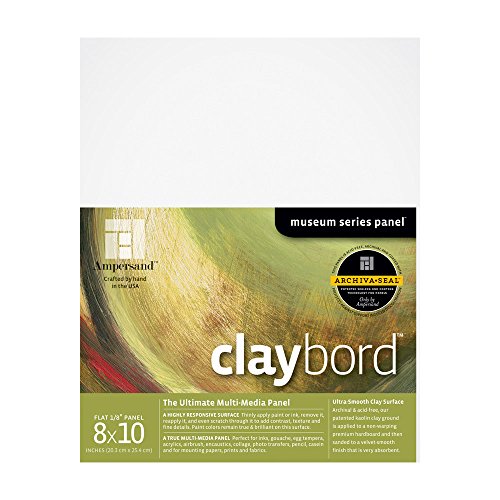
Ampersand Museum Series Claybord CBS08 features a velvety smooth, highly absorbent surface that accepts pencil, India ink, acrylic, gouache, egg tempera, and oils. The panel is ph neutral and archival, allowing finished works to be sealed, varnished, and framed without glass. Best for detail-rich work and mixed-media experiments on a durable substrate.
Best for: Artists who need crisp lines, fine detail, and a resilient ground for ink and light media.
Caution: Large, heavy panels may require careful mounting due to their rigid construction.
Ampersand CBS05 – 5×7 Pack of 3

This 1/8 inch depth pack includes three 5×7 panels with the same velvety smooth, absorbent clay surface as larger boards. It’s ideal for rough sketches, ink studies, and quick field experiments where archival quality matters but panel size is limited.
Best for: Students, note-takers, and traveling artists who want compact, archival surfaces for quick ideas.
Caution: Pack of 3 means multiple small works; store panels flat to avoid warping.
Ampersand CBS11 – 11×14

The 11×14 Claybord panel provides a generous ground for extensive compositions. The velvety surface is highly absorbent and compatible with pencil, ink, acrylic, gouache, egg tempera, and oils. Works can be sealed or varnished and framed without glass for a museum-quality presentation.
Best for: Medium to large works with detailed line work and mixed-media layers.
Caution: Larger panels require appropriate supports and handling to prevent flex or damage during transit.
Ampersand Kaolin Clay 2.5×3.5 – Pack of 5

This small pack introduces a true Kaolin clay surface—the only professional painting panel with an authentic clay ground. It delivers a smooth, ultra-absorbent base ideal for crisp detail and color fidelity. It also supports etching and refining with tools, making it highly controllable for precise work.
Best for: Miniature studies, micro compositions, and technique exploration with high control requirements.
Caution: Small panels can be easily mislaid; handle with care to avoid surface scratches during transport.
Ampersand Aquabord CBT088 – 8×8

Aquabord is a clay-coated hardboard ground designed for watercolor and gouache. Colors can be lifted and erased while wet or dry, and colors tend to retain brightness and purity relative to traditional papers. It’s a durable option for wet-media experiments and clean color control.
Best for: Watercolor and gouache artists seeking liftability and strong color retention on a sturdy panel.
Caution: Because lifting is possible, expect rework opportunities to affect the surface texture over time.
Buying Guide
What is claybord or clay-coated board?
Claybord refers to painting panels with a ground based on kaolin clay or a similarly smooth clay surface. These grounds offer exceptional smoothness, high absorbency, and archival potential, enabling fine detailing and versatile media compatibility.
Who should consider these surfaces?
- Detail-oriented artists who use pencil, ink, or fine lines.
- Gouache, acrylic, tempera, and oil artists seeking a stable ground with minimal warping.
- Mixed-media creators who want a surface that can be etched, scraped, or layered.
Key considerations when choosing
- Panel size and depth: Larger boards offer more space but require sturdy support; depth affects mounting options.
- Ground type: Kaolin clay vs Aquabord clay coating offers different liftability and texture characteristics.
- Media compatibility: Ensure your preferred media works with the chosen ground (e.g., inks, oils, watercolors).
- Archival and finish: Check whether the surface accepts sealing or varnishing for framing without glass.
Practical tips
- Test on a small panel first to assess how your media behaves on the surface.
- Lightly sand or wipe the surface if you plan to rework a heavily layered area.
- Store panels flat to minimize warping and protect edges.
Comparison at a glance
| Product | Best For | Notes |
|---|---|---|
| CBS08 | Detailed ink/pencil work | Velvety, highly absorbent |
| CBS05 | Small studies | Pack of 3, compact |
| CBS11 | Large compositions | Versatile media ground |
| Kaolin 2.5×3.5 | Miniatures | True kaolin clay surface |
| Aquabord CBT088 | Watercolor/gouache | Liftable and vibrant |
FAQ
- What is the main advantage of a claybord surface? It provides a very smooth, absorbent, and archival ground that supports crisp detail and a wide range of media.
- Can I use oils on claybord? Yes, many claybord surfaces are compatible with oils, but controlled sealing and proper finishing are recommended.
- Is Aquabord good for watercolor? Yes, it supports lifting and color retention, making it suitable for watercolor and gouache techniques.
- How should I store these panels? Store flat and away from moisture to prevent warping or edge damage.
- Do these panels require priming? Some surfaces provide ready-to-paint grounds, while others may benefit from priming per the manufacturer’s guidance.
- Which surface is best for travel? The CBS05 pack of small panels is ideal for travel studies and quick experiments.