Discover exciting build-it kits that spark curiosity, teach fundamentals of engineering, and keep kids engaged for hours. These kits are ideal for curious children aged 6–14 who enjoy hands-on learning, creativity, and the satisfaction of building something tangible. The following selections are among the most suitable for various skill levels and interests, from wooden crafts to solar-powered models. Use the quick comparison table below to choose the best fit for your child’s interests and development goals.
| Product | Best For | Why It Stands Out |
|---|---|---|
| Yutin 5 in 1 STEM Kits | Budding designers and DIY crafters | Wooden, multi-activity set with rotating Ferris wheel, windmill, and lights |
| Poraxy 5 in 1 STEM Kits | Young builders who like model cars | Five different model cars in one kit; strong engineering focus |
| choopheme Walkie Talkies STEM Kit | Team projects and communication tech | Hands-on radio frequency science with clear assembly steps |
| SCAEMO Solar Car & Wind Kit | Green tech and renewable energy fans | Solar-powered and wind-powered models in one box |
| LotFancy Bird House Kit | Creative painters and precise crafters | Paint-and-assemble project that blends building with art |
Yutin 5 in 1 STEM Kits for Kids

Best for young crafters who enjoy building and painting. This kit features five different wooden projects inspired by amusement parks, including a rotating Ferris wheel and a fiber optic nightlight. The activity blends traditional woodworking with basic electronics, helping children understand how motors and lights work. The kit comes in a colorful box, making it a keepsake gift or room decor after assembly. Best for ages 8–12 and suitable for a calm, focused play session.
Who it’s best for: kids who prefer hands-on craft projects and want a multi-activity experience in one box. Why selected: the 5-in-1 format provides varied learning moments without needing multiple purchases. Caution: batteries are not included, so expect to supply small power sources for the lights.
Poraxy 5 in 1 STEM Kits for Kids
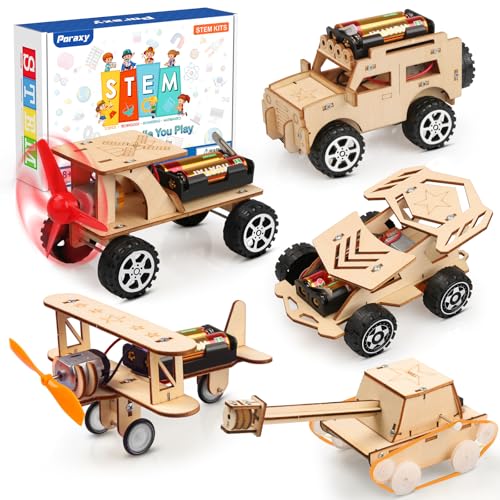
Best for future engineers who enjoy automotive builds. This kit includes five different model cars and all parts needed to assemble them, blending creativity with basic engineering concepts. It aims to reinforce science knowledge while encouraging practical problem solving as kids assemble moving models. Suitable for ages 8–12.
Who it’s best for: children who prefer vehicle-themed projects and hands-on assembly. Why selected: five distinct models offer repeatable play and learning. Caution: small parts may require adult supervision for younger ages or beginners.
choopheme Stem Projects Walkie Talkies

Best for teamwork-oriented learning and communication tech basics. These walkie talkie kits combine STEM with practical talk-time operations and frequency concepts. Easy-to-follow assembly steps and a functional call alert feature help kids learn collaboration and engineering fundamentals outside the classroom. Ideal for ages 8–12.
Who it’s best for: groups of kids or siblings who want a collaborative project. Why selected: integrates electronics with a real-world communication tool. Caution: requires a small screwdriver and some supervision during initial assembly.
SCAEMO STEM Kits: Solar Car & Wind Power

Better for children curious about renewable energy and weather-driven motion. This kit includes a solar-powered car and a wind-powered vehicle, enabling children to observe how sunlight and wind power movement. Built for ages 8–12, it’s a practical, screen-free introduction to energy concepts and basic circuitry. Caution: solar panels can heat up; supervise outdoor use on sunny days.
LotFancy Bird House Kit

Best for artistic kids who love painting and crafting. This kit provides wooden birdhouse pieces, paints, brushes, and simple assembly guidance. Participants practice patience, color coordination, and fine motor skills while creating a decorative bird home. Suitable for ages 4 and up, with adult supervision as needed. Caution: paints are included, so ensure proper ventilation during painting sessions.
Buying Guide: How to Choose the Right Build-It Kit
What should I consider when selecting a build-it kit for my child?
- Age and skill level: Look for kits explicitly designed for the child’s age range to ensure achievable challenges.
- Interest area: Choose themes your child naturally enjoys—vehicles, crafts, nature, or renewable energy.
- Learning vs. play balance: Some kits emphasize education with hands-on building; others lean more toward creative crafting. Pick based on your goals.
- Parts and safety: Check for small parts, required tools, and whether adult supervision is recommended for younger children.
- Storage and mess: Consider kits that come with organized parts and a sturdy box to keep everything tidy after use.
- Expansion potential: Some kits are modular, allowing additional projects or extra components in the future.
Choosing by Activity Type
- Woodworking and painting: LotFancy Bird House Kit fits kids who enjoy painting and assembling wooden pieces.
- Electronics and circuits: Yutin and choopheme provide light and radio-frequency experiences with step-by-step builds.
- Vehicle engineering: Poraxy and SCAEMO combine car or wind/solar-powered mechanics for practical STEM learning.
Safety and Preparation Tips
- Preview the kit contents before starting to ensure you have any missing tools or batteries.
- Provide a clean, well-lit workspace with a flat surface and adequate ventilation for painting or gluing.
- Encourage kids to verbalize steps aloud to reinforce learning and planning.
How to Use These Kits for Maximum Learning
- Set a clear goal for each session, such as completing a specific model or understanding how a motor works.
- Document progress with photos or a simple journal to track improvements and ideas for future projects.
- Discuss real-world connections, like how solar panels convert sunlight to electricity or how gears translate motion.
FAQ
- What age is best for these build-it kits? Most listed kits suit ages 6–14, with some starting at 4 for painting-focused activities. Always check the package for recommended ages.
- Do these kits require additional tools? Some kits include basic tools or require a small screwdriver; others are tool-free. Review the features to know what to have at home.
- Are batteries included? Battery inclusion varies. Some kits require batteries for lights or motors, while others rely on solar power or manual mechanisms.
- Can these kits support multiple sessions? Yes. Many kits are designed for extended play, with components that can be repurposed for future projects.
- Are these kits educational? Most kits are designed to teach STEM concepts through hands-on building, assembly, and basic engineering ideas.
- Is parental supervision recommended? For younger children, supervision is advised during assembly and painting to ensure safety and correct use of tools.