Crochet blocking boards help you set stitches, flatten motifs, and maintain consistent gauge. This guide reviews five highly regarded boards that balance stability, durability, and ease of use. Whether you work granny squares, motifs, or large blankets, these blocking boards provide reliable support and accurate results for American crafters.
The following summary highlights key specs and standout features of the featured products. It helps you compare options at a glance.
| Product | Brand | Key Feature | Approx. Size |
|---|---|---|---|
| CraftyManor Blocking Board | CraftyManor | Stable, rose-pattern border; precise 0.5″ hole spacing; 23 holes/row | 12.5″ square |
| Ouraqto Blocking Board | Ouraqto | Ultra-thick base; 529 holes; 20 pegs; bamboo | 11.8″ x 11.8″ |
| Iswabard Granny Square Blocking Board | Iswabard | Foldable; 1320 holes total; sturdy bamboo base | 23″ x 15.8″ |
| NewEle 12.0″ Blocking Board | NewEle | Integrated storage drawer; 441 holes; 20 pegs | 12″ x 12″ |
| Mr. Pen Interlocking Blocking Mats | Mr. Pen | Interlocking mats; 50 T-pins; reusable | 4 mats x 12″ x 12″ |
CraftyManor 12.5″ Blocking Board With Rose Border

The CraftyManor blocking board is designed to improve stability with a back-hole support structure and two steel pegs. Its rose-pattern border emphasizes elegance while delivering practical blocking with 529 total holes (11″ x 11″ effective area). Hole spacing is 0.5 inches, and holes have a 3mm diameter to fit standard steel pegs. The board is finished with a waxed surface to resist dampness and reduce wear on crochet pieces.
Ouraqto 11.8″ Blocking Board With 20 Pegs
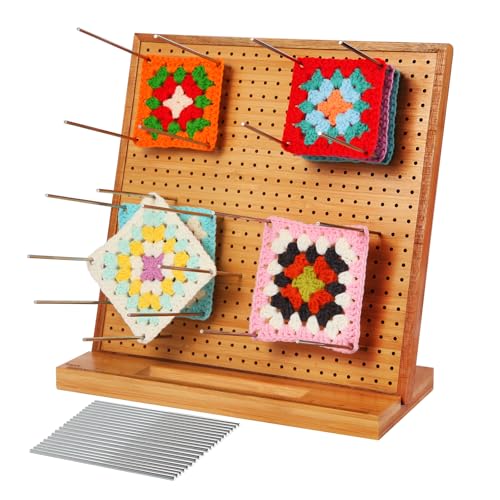
The Ouraqto board features a robust bamboo base with a 0.8-inch thickness for added durability. It comes with 20 stainless steel pins and 529 holes arranged on an 11.8″ square surface. An 11-inch engraved ruler assists with precise sizing, while chamfered holes ensure smooth pin insertion. The board’s bamboo construction promises longevity and reusability for ongoing crochet projects.
Iswabard 23.6 x 15.8-Inch Foldable Blocking Board

Iswabard’s large foldable blocking board expands to 1323 square inches and includes 1320 holes spaced at 0.4 inches. It folds into two sections for compact storage and features a storage area for pins and a stand-compatible outer card slot for keeping a phone or reference book handy. This board is designed for bigger crochet projects and organized workflow, with a durable bamboo base and a stable build.
NewEle 12.0″ Blocking Board With Drawer

The NewEle blocking board integrates a storage drawer with three compartments, accommodating hooks, needles, pins, and small granny squares. The 12″ x 12″ board offers 441 holes across 21 holes per row and includes 20 stainless steel pegs, each 5.9 inches long. The wood surface is polished and smooth, promoting comfortable handling for beginners and experienced crocheters alike.
Mr. Pen Interlocking Blocking Mats (4-Pack)

This set includes four interlocking 12″ x 12″ boards with 50 T-pins. The grid lines on the boards assist with precise measurement and alignment, enabling accurate blocking for multiple projects. The modular mats can be used individually or combined for larger pieces, and they accommodate wet blocking or drying. The included pins fit cleanly into the holes, ensuring straightforward use and repeatable results.
Boye Interlocking Blocking Boards (4-Pack)

Boye’s four 12″ x 12″ boards interlock to form larger blocking surfaces or can be used separately for smaller pieces. Each board features grid lines and a consistent 12″ x 12″ footprint, helping knitters and crocheters achieve straight edges and uniform stitches. This modular system is well-suited for diverse projects from small motifs to larger blankets.
11.8″ Bamboo Blocking Board With 16 Pins

HHSarioneiro’s 11.8″ board uses durable bamboo with 16 stainless steel pins. It features 529 holes (23 per row) arranged on a compact surface and integrates chamfered holes for smooth pin insertion. The bamboo construction emphasizes longevity and reusability, making it a practical choice for beginners and seasoned crocheters alike.
Buying Guide: Key Blocking Board Considerations
When choosing a crochet blocking board, consider stability, material, hole density, and storage features. Mechanical stability matters for larger projects; boards with solid edges, reinforced backings, or wider bases reduce wobble during pin insertion. Material choices—bamboo, wood, or composite—affect durability and maintenance. Hole density affects precision and the number of pins needed; more holes allow intricate shaping but require more pins to fill. Storage features, like drawers or built-in pin storage, help maintain a tidy workspace. Foldable designs improve portability and space efficiency, especially for crafters with limited workspace. Interlocking mats offer scalable surfaces for large blankets, while fixed boards suit smaller motifs. Consider your typical project size, pin availability, and workspace layout to select the best board for your crochet blocking needs.
Other considerations include finished edge quality, ease of cleaning, and whether the board supports both wet blocking and drying processes. Some boards emphasize aesthetics (like rose borders) or include measurement aids (rulers or engraved scales). For beginners, a thicker base and chamfered pin holes reduce the risk of hand fatigue and pin injury. For advanced crocheters, high hole density and modular options enable more precise blocking of complex grids and large motifs. In short, pick a blocking board that aligns with project scale, storage constraints, and personal blocking workflow.