The best 8.5 x 11 graph paper depends on how you plan to store and use it. Amazon Basics is a practical pick for buyers who need a large supply of pad sheets, Oxford suits binder users, and Mr. Pen offers a single pad for everyday math or technical drawing. For tear-off sheets, consider Zaviko or Aidunmis, which provide perforated pads with blue 4×4 grids.
| Product | Best For | Format |
|---|---|---|
| Amazon Basics Quad-Ruled Pad | High-volume use | Six pads, 600 sheets total |
| Oxford Filler Paper | Binders | 400 loose-leaf sheets |
| Mr. Pen Graph Paper Pad | Single-pad use | 55 sheets |
| Zaviko Graph Paper Pad | Perforated tear-off sheets | Two pads, 60 sheets total |
| Aidunmis Graph Paper Pads | Multiple portable pads | Three pads, 90 sheets total |
Amazon Basics Quad-Ruled Graph Paper Pad

Best for: Students, classrooms, and home offices that use graph paper regularly. This multipack contains six pads with 100 sheets each, for 600 sheets total. The 8.5-by-11-inch white paper has a 4×4 grid, meaning four squares per inch, and the sheets are perforated for removal.
The standard letter-size format works for common school assignments and general graphing. The listed paper weight is 20-pound. Choose this option if you want a large supply in pad form rather than loose sheets for a binder.
Limitation: The product information does not specify paper thickness beyond its 20-pound description or state that the sheets are suitable for use on both sides.
Oxford 4×4 Graph-Ruled Filler Paper
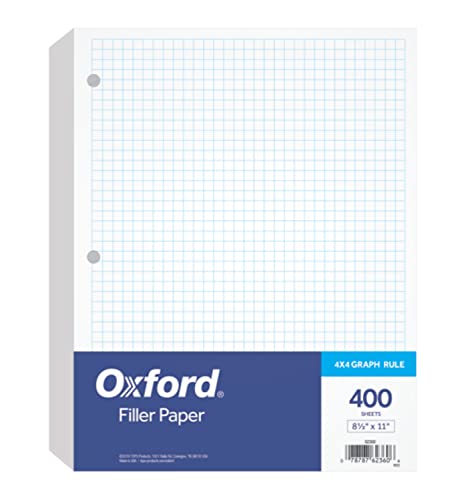
Best for: Buyers who want graph paper organized in a standard three-ring binder. This pack includes 400 double-sided, 8.5-by-11-inch sheets with a 4×4 graph rule. The sheets are three-hole punched to fit standard ring binders or pocket folders with fasteners.
Oxford is a better fit than a bound pad when you want to rearrange, file, or carry graph sheets in a binder. The listed uses include elementary math, geometry, calculus, trigonometry, physics, and art projects.
Limitation: These are loose-leaf sheets, not a tear-off pad. Choose another format if you prefer pages secured together in a notebook-style pad.
Mr. Pen 55-Sheet Graph Paper Pad
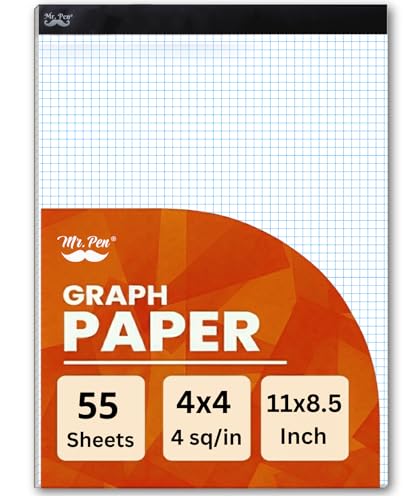
Best for: Buyers who want one compact supply of letter-size graph paper for classwork, notes, or drawing. The pad has 55 sheets with a quadrille 4×4 grid, or four squares per inch. The manufacturer describes the paper as thick enough to help prevent ink bleed and says it can be used on both sides.
This is a straightforward option for technical and engineering drawing as well as note-taking. It offers more sheets than a 30-sheet pad while avoiding the bulk of a multi-pad pack.
Limitation: The provided product details do not state whether the sheets are perforated, so buyers who need clean tear-off pages should verify that feature before choosing it.
Zaviko 4×4 Graph Paper Pad, Two-Pack

Best for: People who want removable sheets for homework, sketches, or diagrams. This package includes two pads with 30 sheets each. The 8.5-by-11-inch paper is 70 GSM, with blue 4×4 grid lines and perforations along the top for tearing sheets from the pad.
Zaviko is a good match for buyers who prefer a pad but sometimes need to hand in or carry individual pages. The product description says the paper can be used on both sides and is designed to resist ink bleed. Its listed applications include algebra, geometry, trigonometry, calculus, physics, and technical drawing.
Limitation: The pack contains 60 sheets total, so it provides less paper than the 400- or 600-sheet options.
Aidunmis Three-Pack Graph Paper Pads

Best for: Buyers who want several small pads for different subjects or locations. The set includes three 30-sheet pads, for 90 sheets total. Each pad uses 8.5-by-11-inch, 70 GSM white paper with blue 4×4 grid lines, top perforations, and a cardboard backer.
The perforations support neat page removal, while the described dual-sided usability may help users make use of both sides. The sturdy backer is a useful detail for writing when a desk is not available. The product is described for drafting, drawing, engineering, and schoolwork.
Limitation: Each pad contains 30 sheets, so this set may be less convenient than a large-volume pack for frequent, high-volume use.
Buying Guide: How to Choose 8.5 x 11 Graph Paper
Do you need a pad or loose-leaf paper?
Choose a pad if you want sheets held together and may tear them out as needed. Check for perforations when clean removal matters. Choose three-hole-punched filler paper if you plan to keep pages in a standard binder and rearrange them.
How many sheets do you use?
Compare total sheet counts, not just the number of pads. The options here range from a 55-sheet pad to packs containing 400 or 600 sheets. Multi-pad sets can be convenient for splitting supplies across classes, desks, or work areas.
What grid spacing should you check?
These products use a 4×4 grid, which means four squares per inch. Confirm the grid specification before buying if an assignment or drawing requires a particular scale. Blue lines are specified for several of the pad options, while the Amazon Basics description identifies the grid but does not state its color.
Will you write on both sides?
Some listings specifically describe the paper as usable on both sides or resistant to ink bleed. If double-sided writing is important, check the product details for that claim. Paper weight alone does not guarantee that every pen or marker will work without show-through.
Frequently Asked Questions
What does 4×4 graph paper mean?
It means the grid has four squares per inch in each direction, creating quarter-inch squares.
Is 8.5 x 11 graph paper standard letter size?
Yes. A sheet measuring 8.5 by 11 inches uses the common U.S. letter-size format.
Which type is best for a three-ring binder?
Three-hole-punched loose-leaf paper, such as the Oxford option, is made for standard ring binders.
Which option has the most sheets?
The Amazon Basics multipack has 600 sheets total. Oxford offers 400 sheets in one pack.
Are perforated graph paper sheets removable?
Perforated sheets are designed to tear away along the perforation. Check the listing if clean removal is a priority, since not every pad description specifies this feature.