Answer: 220 grit sanding sponges are ideal for fine finishing, between-coat prep, and detail work on wood, metal, drywall, and painted surfaces. This guide highlights five top 220 grit options, showing who each product is best for and why they stand out. Use these blocks for hand sanding in tight spots, edges, and curved surfaces where power sanders can’t reach.
Summary of selected products:
| Product | Use Case | Best For |
|---|---|---|
| 3M Pro Grade Precision 3-in-1 Sanding Sponge | Contoured, angled, and flat sides | Detail work and all-around prep |
| 8 Pack MOWPOG Sanding Sponge Block | Fine, reusable, ideal for hand sanding | All-around drywall, wood, and trim |
| S&F STEAD & FAST 4 Pcs Sanding Sponge | Heavy-duty, high-density foam | Wood, metal, automotive prep |
| Pukamam 12 Pack Sanding Sponge | High quantity and versatility | DIY projects with multiple surfaces |
| SACKORANGE 4 Pack Hand Sanding Sponge Set | Color-coded grits 120–400 | Coarse to fine refinishing projects |
3M Pro Grade Precision 3-in-1 Sanding Sponge
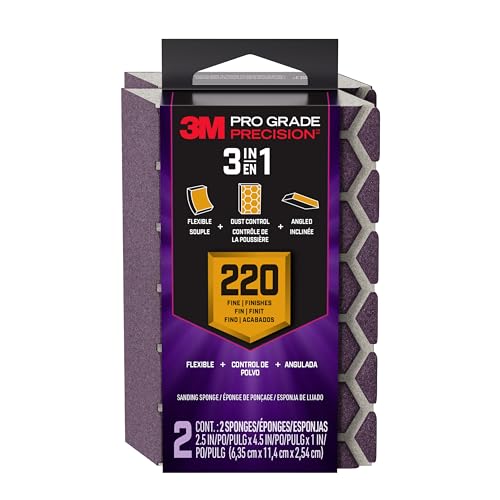
Features include a 220 grit finish for light sanding, scuffing, and between-coat prep. The 3-in-1 design provides contoured, angled, and flat sides to cover detailed to large surface work. The sponge is washable and reusable, preserving performance across multiple projects.
Best for: hobbyists and professionals who need flexible coverage on curved profiles, trim, and between-coat prep. This option is particularly strong for projects requiring precision around edges and contours.
Caution: While durable, extended heavy sanding on extremely hard materials can wear the grit faster than on softer surfaces.
8 Pack Sanding Sponge Block by MOWPOG

Includes eight 4″ x 2.75″ x 0.65″ blocks with 220 grit. Made from high-elastic sponge and premium brown corundum for flexibility and longevity. Reusable and washable, suitable for dry or wet sanding, and ideal for areas a power sander may miss.
Best for: DIYers and hand-sanding enthusiasts who need a bundle of blocks for multiple projects or rooms. The set is strong for drywall, wood, and finishing touches on trim.
Limitation: Bulk packaging can be more than needed for small tasks, but provides excellent value per project.
Pukamam 12 Pack Sanding Sponge, 220 Grit

This 12-piece set provides double-sided 220 grit sanding sponges, each 4.7″ x 3.9″ x 2.7″. The materials balance high-density sponge with aluminum oxide abrasive for durability and flexibility. The blocks are washable and reusable and can be cut to fit complex shapes.
Best for: Larger projects and surfaces where you want to keep a ready supply of sponges. Great for furniture refinishing, panels, and drywall preps in multiple rooms.
Limitation: Larger size may be less maneuverable on tight curves without cutting.
SACKORANGE 4 Pack Hand Sanding Sponge Set

This set includes 120, 220, 320, and 400 grits, color-coded for easy identification. The high-density sponge is flexible and tear-resistant, with long-lasting abrasive particles. Suitable for woodworking, furniture polishing, drywall, primer smoothing, and wood filler finishing.
Best for: DIYers who want a complete grit progression in one purchase, enabling quick transitions from rough shaping to fine finishing. It’s useful for both new projects and refinishing tasks.
Limitation: The set focuses on standard surfaces; extremely dense materials may require heavier grit or power sanding for speed.
S&F STEAD & FAST Sanding Sponge 220 Grit (4 Pcs)

Premium European high-density foam delivers strong rebound and longevity for heavy-duty hand sanding. The 220 grit aluminum oxide block features a triple-layer PU construction for flexibility and tear resistance, with a claimed 2-3x longer lifespan than standard blocks. Suitable for wood, metal, drywall, and automotive finishing.
Best for: Projects requiring robust performance under frequent use, such as workshop finishing or metalworking prep. Choose this if you need extra durability and shape retention.
Limitation: Higher-density foam can feel stiffer, making very delicate curves slightly harder to follow without careful control.
Buying Guide: Key Considerations for 220 Grit Sanding Sponges
- Intended surface: Choose 220 grit if you need fine finishing, between-coat prep, or smoothing of edges. For heavy material removal, consider coarser grits first.
- Block design and grip: Contoured, flat, or multi-sided designs help with edges and curves. Ergonomic handles reduce fatigue during extended sanding sessions.
- Material durability: Look for high-density foam and robust abrasive bonds to prevent shedding and prolong life, especially in damp environments.
- Wet vs dry use: Most 220 grit sponges are versatile for wet or dry sanding. Wet sanding reduces dust and can improve finish quality on wood and paint.
- Size and flexibility: Larger blocks cover more area but may be less maneuverable in tight spots. Smaller, flexible blocks excel around corners and trim.
- Maintenance: Washable sponges save money over time. Proper cleaning after use extends life and prevents contaminant buildup between projects.
- Cost and value: Bundled packs save per-piece cost. For frequent projects, a larger set may offer better long-term value.
Frequently Asked Questions
- What is 220 grit best used for? Answer: Fine finishing, between-coat prep, and smoothing minor imperfections on wood, metal, drywall, and paint.
- Should I wet or dry sand with 220 grit? Answer: Both are common; wet sanding reduces dust and can improve finish, while dry sanding is faster for initial smoothing.
- How do I choose the right sponge design? Answer: Contoured edges help with curves; flat surfaces work well on large flat areas; multi-sided designs aid in detail work.
- Can I cut sanding sponges to fit irregular shapes? Answer: Yes, many sponges are easy to cut to fit complex contours or fixtures.
- Are 12-pack or 8-pack sets better for beginners? Answer: Beginners benefit from multi-pack sets for discovering preferences and for completing multi-room projects over time.
- Do these sponges wear out quickly? Answer: Durability depends on density, abrasive bond, and use; high-density foams with robust bonds last longer under typical hand sanding tasks.